I found this video online that visually explains gravity. There are several such videos which explains why two objects with mass has gravity between them. What's fascinating in this video is that it not only explains the gravitational pull, but also the orbit of smaller objects around the larger objects, the elliptical orbit that planets take, the anti-clock-wise revolution of all planets around the sun (except of course Venus), and many more. The best part of this video is that it is not explained in computer graphics but explained practically. Watch and enjoy.
14 December 2014

11 May 2014
The Lord of the Rings
Hi all. It's been a while since I updated this blog. So here it is. Some of the pics of Saturn I took over a year ago.
Used a 6-inch Newtonian Reflector Telescope and Nikon D5100. Took these pics in a-focal method. Removed the camera lens and placed it facing the telescope eye-piece so that the telescope would act as a camera lens.
These are unadulterated pics taken at 20 sec exposure and I don't actually remember the ISO settings. These pics were taken from my terrace (in the middle of the city) so you would find some light pollution in them.


I was unable to stack these images and so I ended up photoshopping it. Removed the light pollution, increased the brightness and sharpened the image. Here is the result.

And here's a blown-up version of the same. If you look closely, you can make out the shadow of the planet on it's rings. Cassini's Division, not very clear. Hopefully when I get a better eye-piece.

Used a 6-inch Newtonian Reflector Telescope and Nikon D5100. Took these pics in a-focal method. Removed the camera lens and placed it facing the telescope eye-piece so that the telescope would act as a camera lens.
These are unadulterated pics taken at 20 sec exposure and I don't actually remember the ISO settings. These pics were taken from my terrace (in the middle of the city) so you would find some light pollution in them.


I was unable to stack these images and so I ended up photoshopping it. Removed the light pollution, increased the brightness and sharpened the image. Here is the result.
And here's a blown-up version of the same. If you look closely, you can make out the shadow of the planet on it's rings. Cassini's Division, not very clear. Hopefully when I get a better eye-piece.

7 June 2013
Silver Rock Photoshoot
Below are few of my first snaps of the Moon taken on April 3rd, 2013, using Nikon D5100 along with my M42 (Orion StarSeeker 130 Telescope). Also used a Moon Filter. These photos were taken using afocal method and so the images are not properly focused.


12 May 2013
Spotting the ISS
It was on the evening of 2nd of May, I was riding on my way to work. Just as I was climbing Kattipara Jn, I saw a bright red object in the sky, quite close to Jupiter. I was quite surprised as there couldn't be any object so close to the Jupiter. I looked up again and realized it was moving slowing past the giant planet. I knew it had to be a satellite. After a week, I was checking the Stellarium to find out what that satellite was and I was surprised to know it was none other than ISS (International Space Station). Below is a screen shot from Stellarium.

18 March 2013
Milky Way - A Magic Beyond Imagination
Living in the heart of the city, it is impossible for us to see the beauty of the Milky Way. But we can see this natural beauty with the help of a digital camera. Last month, I went to the Marina Beach as early as 4:00 in the morning with my friend's DSLR (Nikon D5100). Using the Sky Map Android App, I identified the spot where the Milky Way would be at its brightest and took a few snaps of the night sky. And below is the result I got.

The above picture was an epic failure. At first I tried to take the photos with different settings of ISO, aperture and shutter speed. After taking about 8 photos, I thought the above picture was the best I could get. What a disappointment! The picture contains some bright stars and a lot of sky noise. Could see a bit of Orang-ish colour on the right end, thanks to the Light House. I expected to see atleast a bit of the Milky Way, but found nothing. Disappointed, I went back home.
I then uploaded my pics to my system. I tried to zoom in the picture to see if I could spot anything at all. And then I found something. It could just be some clouds. Or maybe its the Milky Way. I uploaded the photo into the PhotoShop and tried to remove some of the sky noise. And this is what I got.

It is the Milky Way! No doubt. I was literally jumping with joy. The morning was not in vain after all. Now I wanted to know if I could do any better with this picture. I think its best for me to mention that this was my first ever experiment with the PhotoShop. After trying to remove more sky noise, this is what I got.

Neat!!! But not enough. The Light House has played a spoil-sport. I wanted to remove that Orange noise on the right end. I tried various methods but removing the noise made the picture worse. After nearly experimenting for 2 weeks with the PhotoShop, I believe I got the best out of the ordinary picture I took.

11 March 2013
Airplane near Orion

Above is a picture I clicked a few months ago. I was trying to take a picture of the Orion Constellation when I realized an airplane had traveled right through the frame. After using the Photoshop to remove the sky noise (noise formed due to the city lights) the trail of the Airplane was visible clearly.
The almost straight line in the bottom-middle of the picture is formed by the Airplane due to the 20-sec exposure. The White dots and the red dots around the line are caused by the flickering navigation lights of the Airplane.
Apart from the Airplane we can also see the Orion Nebula shining bright along with Rigel and the Red Supergaint, Betelguese.
6 March 2013
Comet Pan-STARRS - First Look
Below is the first picture of the Comet Pan-STARRS. The Comet looks really bright and promising. The Comet is currently visible in the Southern Hemisphere during the evening after sunset. In the Northern Hemisphere, the comet is still very close to the Sun and it cannot be seen yet.
 |
| Comet Pan-STARRS illuminates the evening sky with a spectacular tail in Buenos Aires, Argentina on March 2, 2013 |
The Comet is expected to make an appearance in the Northern Hemisphere by March 10th. Keep your binoculars and DSLRs ready.
17 February 2013
Russian Meteorite has nothing to do with 2012 DA14
This story begins approximately a year back. In February 23,
2012, a free asteroid was discovered. It was calculated that this asteroid
would travel very close to Earth on February 15, 2013. This asteroid was named
2012 DA14. This asteroid was approximately 50 meters in diameter. The asteroid
was said to travel as close as 30,000 km from Earth which is closer than the
Geosynchronous orbit (Orbits of Geosynchronous Satellites).
 |
| An Artistic Impression of Earth and Asteroid 2012 DA14 |
 |
| Trajectory of Asteroid 2012 DA14 |
About 15 hours before the passing of this asteroid there was
a meteor event near Chelyabinsk, Russia. An object (now called Chelyabinsk
Meteor) from space entered the Earth’s atmosphere thereby becoming a fireball.
This object was estimated to be of a diameter of 17 meters. This object was
undetected until it reached the atmosphere due to its relatively small size.
This object was said to have been travelling at a speed of 108000 km/h before
impact. The energy released by this meteor was said to be 500 kilotons of TNT
which is 20-30 times more than that of the atom bombs of Hiroshima and
Nagasaki. This energy created a shock wave which injured about 1200 people
mainly due to the glass shattered from windows. Three impact sites of the
meteor were found. One of the impact sites had fragments of the meteorite.
 |
| Trail left over by Chelyabinsk Meteor |
NASA and ESA (European Space Agency) confirmed that the Chelyabinsk
Meteor had nothing to do with the asteroid 2012 DA14. The asteroid continued to
pass through about 15 hours after the event. They are still investigating on
the meteor.
A video of the Meteor and the shock wave it left
10 February 2013
Where to Look for Comet Pan-STARRS
Amateur Comet Hunters who do not know where to look for the
Comet Pan-STARRS, I hope that this article would help you. I
have taken a few screenshots with the help of online Planetarium Neave, and marked
the location of the Comet.
This is the position of the Sun and the Comet on Feb 25th at about 06:00 pm. Since the altitude of the Comet is lower to that of the Sun, the Comet would not be visible.

On March 2nd, the Comet would have traveled a little higher in altitude, but it still wouldn't be visible.

On March 7th, the Comet looks to be at a good viewable altitude. Not sure if the Comet will be visible then. The first visibility of the Comet should be any day between March 7th and March 10th.

On March 12th the Comet should definitely be visible since its altitude is higher to that of the Sun. Lets hope its bright enough with a long tail and most importantly, let's hope its a clear sky.

The below illustration shows how the Comet may look like on March 12th, 16th 20th and 24th. Definitely looks promising. Make sure you enjoy this rare evening beauty throughout March.

Below is the first photograph of the Comet with a tail. This was shot in New Zealand in January.

3 February 2013
Comets of 2013
Comets are
unique objects which are a part of our Solar System. They are basically
asteroids which take more of a unusual orbital path around the Sun. Comets are
distinguished from Asteroids by its tail. The nucleus of a Comet is made
up of icy particles and they start to melt as they go close to the Sun, which
forms the tail. The tail never tells us the direction of the Comet’s path but it
always points away from the Sun. Not all comets have a tail. Some tails are
tiny and cannot be seen. Few tails are larger than the Comet itself and few take
up a weird shape.
The most
famous of all Comets is the Halley’s Comet which appears once every 76 years.
This comet has been recorded since 240 BC until its last appearance in 1986. It
is expected to appear again in 2061. The last visible appearance of a Comet was
Hale-Bopp in 1997.
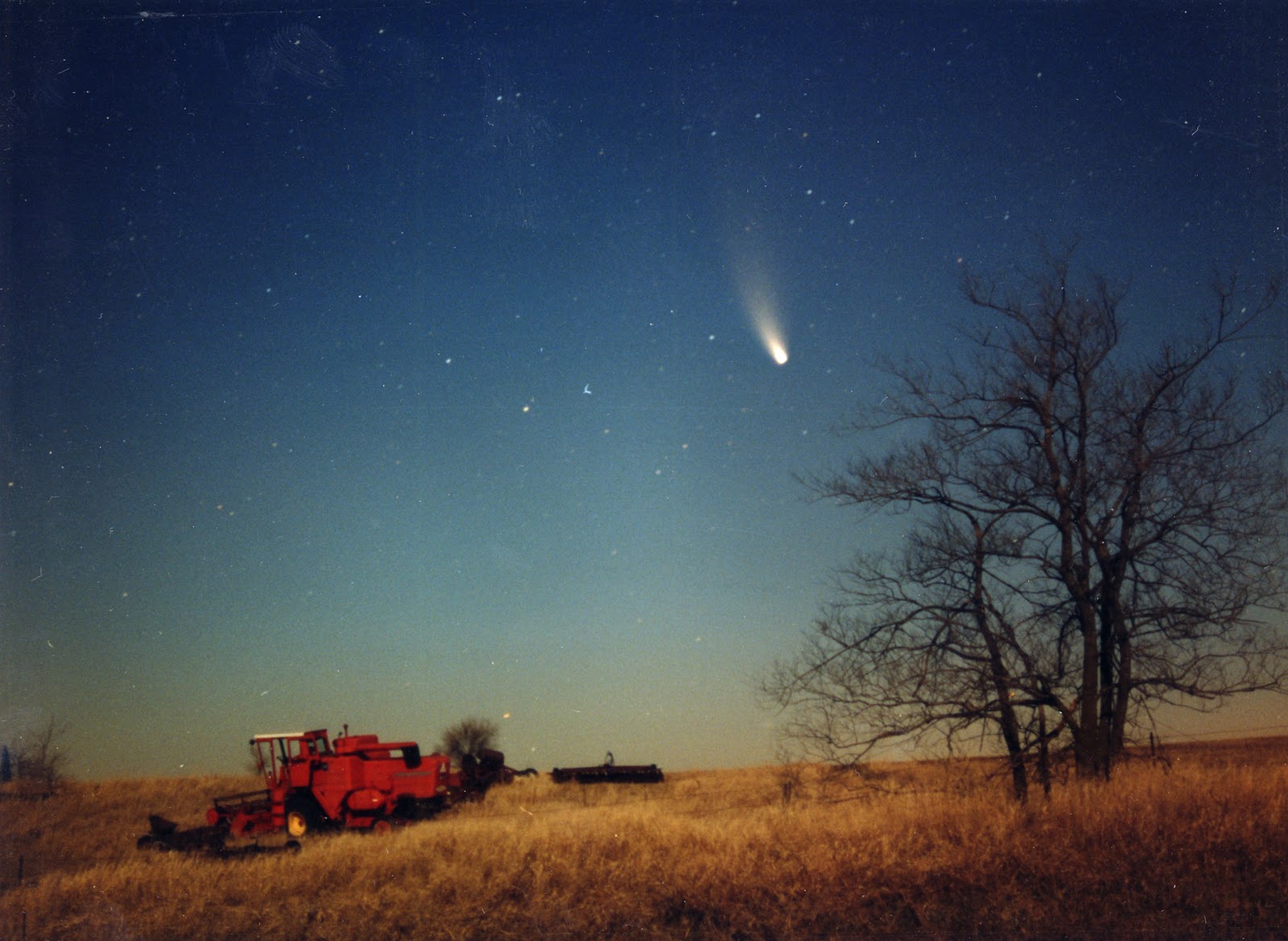 |
| Comet Hale-Bopp in 1997 |
Comets are
rare. They need to be both closer to the Earth and Sun for us to see the tail
with our naked eye. Lots of Comets were discovered since Hale-Bopp but none of
it made a grand appearance. But 2013 is in for a surprise.
Two Comets
were discovered recently that can give out a decent appearance (at least) this
year. Comet C/2011 L4 (PANSTARRS) is expected to appear bright in the evening
sky in the second week of March. And Comet C/2012 S1 (ISON) is expected to
appear in late November. Both these comets are expected to be bright enough to
be seen by our naked eye. But a beauty of a Comet depends on its tail. So
nothing can be promised until the Comet makes the appearance. Comet ISON is
expected to be the Comet of the Century (just predictions) but November is
still at far. Let’s keep our focus on PANSTARRS for now.
With only 4
weeks away, Comet PANSTARRS is too close to the Sun for us to see it now. We
can only see the Comet in the second week of March (approx on Mar 10). Keep an eye out in the West
during and after sunset. The Comet may last the entire March and April but only
if it acts as it has been predicted to do. Keep your cameras ready and keep
your fingers crossed.

19 August 2012
Evolution of Stars

The above image is the simplest explanation of the life of a star. How they are born or created from a stellar cloud and how they end up as a White Dwarf or Neutron Star or a Black Hole. Our Sun is a small star and hence it will end up as a White Dwarf.
Check out my other post for more details.
Life of a Star
Black Hole
Supernova
6 June 2012
Venus Transit - An Experience
When I finished work early this morning, first thing I did
was to take a snap of the Sun by covering my camera lens with a dense x-ray
sheet. It wasn’t good enough. The picture of the Sun wasn’t really clear and I wasn't able to see the Venus.
I rushed home and took out the eclipse glass I created
(by covering an X-ray sheet over my goggles). I wore my goggles and I was able to
see the Sun clearly and most importantly a tiny little dot (Venus). For a moment I
thought I imagined it!

Looking at the Sun and Venus through my own eclipse glass
Though I was able to see the Venus, I wasn’t satisfied with that. I needed to take a snap in order to preserve the moment. An idea struck me! I pulled out an old broken binocular and a cardboard. I made a circular hole in the cardboard and stuck the front end of the binoculars to it. I directed the binoculars to the Sun. Now the Sun light was passing through binoculars’ lens and the cardboard created a shadow around it.

Binoculars covered by the cardboard directed towards the Sun
I then placed an A4 sheet behind the rear end of the binoculars.
Now the binoculars were creating a projection of the Sun. But no sign of Venus!
After a lot of adjustments and focus, was finally able to see the Venus! And
what’s better? I wasn’t just able to take a snap but a video as well.

Projection of the Sun from the Binoculars
I had to re-arrange the setup every few minutes due to the
Sun’s movement in the sky. At around 9:00 IST a heavy wind blew away my setup
and my binoculars were damaged beyond repair. I wanted to take snaps until
Venus moves out of the Sun but unfortunately that wasn't possible.
Below are the snaps I took of the Venus Transit and also a video!
A video of the Projection (No Audio. And Venus wasn't clear since I had the flash on by mistake)


The above three pictures were taken at 7:18 IST

At 8:06 IST

At 8:38 IST

At 8:57 IST
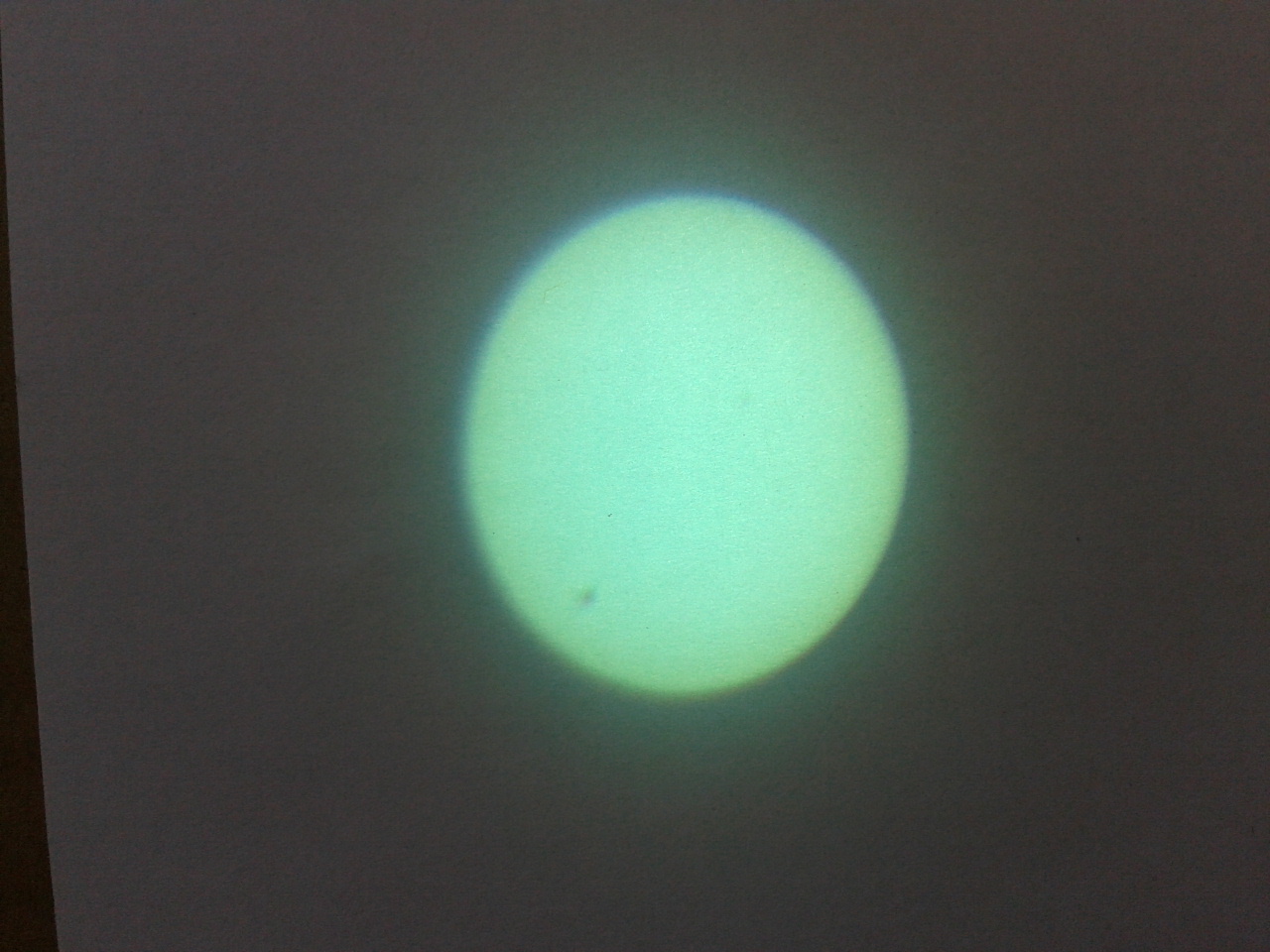
At 8:58 IST

My setup dismantled after my binoculars broke into parts
28 May 2012
Transit of Venus
In two weeks time (June 6, 2012, Wednesday) Venus, who has
been glittering in the evening sky over the past few months will transit the Sun for the second time this century. The last time the transit occurred was on
June 8, 2004. For those who missed it last time better catch it this time or
you will never get another chance to see it. The next transit will occur only
on December 11, 2117.

An animated view of Venus Transit in 2004
This year’s transit will occur between 3:39am IST to 10:19am
IST. We would only be able to see it only after sun rise which is approximately
5:30am IST.
A transit is nothing but an occultation (just like an
eclipse) when a planet (usually Mercury or Venus) comes in between Earth and
Sun. Unlike the Moon, the planet cannot block the entire Sun since it is very
small from Earth’s perspective. Hence we can see the planet only as a tiny dot over
the Sun.
Best way to look at the transit is by using an Eclipse
Shades or Welder’s Glass. DO NOT look directly into the Sun as it may cause
damage to your eyes. Neither try to look at it using Sun Glasses as it does not
block out the Sun’s brightness completely.

Venus Transits Past, Present and Future
Below are the three images of the upcoming Transit that I took using the application 'Stellarium'. The first image is how the transit will look at sunrise (5:40am IST). The second one is at 8:00am IST and the third is at 10:00am IST. Click on the images to get a clear view of the transit.

Transit at 5:40am IST

Transit at 8:00am IST

Transit at 10:00am IST
19 March 2011
Brightest Moon in Two Decades
Tonight the Moon will be closest to Earth in 18 years making it the biggest and the brightest since then. With all the hype created over the last week I really wanted to know what's the big deal. Last two days the moon really looked big enough at sun set. Just a while back I took a walk to my garden to check its brightness and it was bright enough. The shadow created by the moon was so dark and the garden was so well illuminated that I felt like sitting in there for an hour chilling out (I had bought a KFC bucket with chilled Pepsi) but for those ridiculous mosquitoes. Yet I feel all the hype ("Super Moon") wasn't worth it. It's still worth to have a look.
30 November 2010
Picture of the Month - November 2010

The above two images were taken on an early morning on 5th of November. This picture shows the thinnest Moon you can ever see. The thin crescent Moon was accompanied by a crescent Venus, shining bright, right before the sun rise. The crescent shape of the Venus is quite clearly seen in the above picture.
The phases of Venus was first identified by Galileo Galilei when he looked through his telescope for the first time on 1610, which confirmed the theory of heliocentric (Sun is in the center of the Solar System) which was proposed by Copernicus.
15 October 2010
Picture of the Month - October 2010

You must be wondering what those two bright objects at the bottom left of the picture is. It can't be Venus, since Venus doesn't have any satellite. It can't be Jupiter since none of the Jupiter's satellite are big enough as in the picture. It can't be Mars since Mars appears red. What else could it be? A binary star?
Well, that's it how Earth and Moon looks like from Mercury. This picture was captured by MESSENGER (MErcury Surface, Space ENvironment, GEochemistry and Ranging), a spacecraft sent to Mercury by NASA, which was launched in 2004.
27 September 2010
Picture of the Month - September 2010

20 September 2010
Jupiter At Its Brightest!
Anytime you look into the night sky you can see that the brightest object is the Moon, followed up by Venus and Jupiter. For the last few weeks I had been enjoying the beauty of Venus in the west and just as Venus sets, Jupiter rises in the east. I am waiting for the Venus to shift its position so that can I see Venus in the east and Jupiter in the west at the same time. I haven't seen them together since the 'Great Smile Incident', Dec 2008.

Also to add an interesting fact, Jupiter is found to be the closest to Earth tonight since 1963. It will be just 368 million miles away from Earth. So Jupiter is going to very bright today (though not as bright as Venus). So keep an eye on Jupiter tonight!

Venus on the top-left, Jupiter on the top-right, Moon in the bottom-middle. The Great Smile.
Also to add an interesting fact, Jupiter is found to be the closest to Earth tonight since 1963. It will be just 368 million miles away from Earth. So Jupiter is going to very bright today (though not as bright as Venus). So keep an eye on Jupiter tonight!
15 August 2010
Picture of the Month - August 2010

The above picture is taken during a Total Solar Eclipse. A strange shadow of darkness can be seen around the sun. This is called as Shadow Cones and they are visible due to the scattering of sunlight in the atmosphere. Shadow Cones are particularly dramatic when the eclipse is near the horizon. The above picture of Shadow Cone was taken last month from Patagonia, Argentina along with the background of Andes Mountains.
15 July 2010
Picture of the Month - July 2010

This is one of the most beautiful pictures taken by International Space Station (ISS). While orbiting around the Earth in July 2006, the astronauts captured the Moon floating near the horizon and the Earth covered by a thick blanket of clouds. You can notice that a part of the moon appears blue. This is created by the atmosphere around the Earth. The Air Molecules in the atmosphere scatter the blue light which makes the sky look blue from Earth and the horizon look blue from space. Also the atmosphere deflect the Moon's light which makes the lower end of the Moon appear to fade.
Subscribe to:
Posts (Atom)