I found this video online that visually explains gravity. There are several such videos which explains why two objects with mass has gravity between them. What's fascinating in this video is that it not only explains the gravitational pull, but also the orbit of smaller objects around the larger objects, the elliptical orbit that planets take, the anti-clock-wise revolution of all planets around the sun (except of course Venus), and many more. The best part of this video is that it is not explained in computer graphics but explained practically. Watch and enjoy.
Showing posts with label Satellites. Show all posts
Showing posts with label Satellites. Show all posts
14 December 2014

15 October 2010
Picture of the Month - October 2010

You must be wondering what those two bright objects at the bottom left of the picture is. It can't be Venus, since Venus doesn't have any satellite. It can't be Jupiter since none of the Jupiter's satellite are big enough as in the picture. It can't be Mars since Mars appears red. What else could it be? A binary star?
Well, that's it how Earth and Moon looks like from Mercury. This picture was captured by MESSENGER (MErcury Surface, Space ENvironment, GEochemistry and Ranging), a spacecraft sent to Mercury by NASA, which was launched in 2004.
27 September 2010
Picture of the Month - September 2010

20 September 2010
Jupiter At Its Brightest!
Anytime you look into the night sky you can see that the brightest object is the Moon, followed up by Venus and Jupiter. For the last few weeks I had been enjoying the beauty of Venus in the west and just as Venus sets, Jupiter rises in the east. I am waiting for the Venus to shift its position so that can I see Venus in the east and Jupiter in the west at the same time. I haven't seen them together since the 'Great Smile Incident', Dec 2008.

Also to add an interesting fact, Jupiter is found to be the closest to Earth tonight since 1963. It will be just 368 million miles away from Earth. So Jupiter is going to very bright today (though not as bright as Venus). So keep an eye on Jupiter tonight!

Venus on the top-left, Jupiter on the top-right, Moon in the bottom-middle. The Great Smile.
Also to add an interesting fact, Jupiter is found to be the closest to Earth tonight since 1963. It will be just 368 million miles away from Earth. So Jupiter is going to very bright today (though not as bright as Venus). So keep an eye on Jupiter tonight!
15 August 2010
Picture of the Month - August 2010

The above picture is taken during a Total Solar Eclipse. A strange shadow of darkness can be seen around the sun. This is called as Shadow Cones and they are visible due to the scattering of sunlight in the atmosphere. Shadow Cones are particularly dramatic when the eclipse is near the horizon. The above picture of Shadow Cone was taken last month from Patagonia, Argentina along with the background of Andes Mountains.
15 July 2010
Picture of the Month - July 2010

This is one of the most beautiful pictures taken by International Space Station (ISS). While orbiting around the Earth in July 2006, the astronauts captured the Moon floating near the horizon and the Earth covered by a thick blanket of clouds. You can notice that a part of the moon appears blue. This is created by the atmosphere around the Earth. The Air Molecules in the atmosphere scatter the blue light which makes the sky look blue from Earth and the horizon look blue from space. Also the atmosphere deflect the Moon's light which makes the lower end of the Moon appear to fade.
17 May 2010
Picture of the Month - May 2010

This most amazing picture is a combination of 8 images taken at Portsmouth, UK at 7:50 pm between April 4th to April 15th, 2010. This composite image shows the trail of Venus and Mercury with a beautiful backdrop. Venus (extreme left) was continuing to move away from the Sun during the time while Mercury (in the center) was rising until April 11th and then began to fall. The movement of both the planets are due to the revolution around the Sun with Mercury reaching the furthest distance from the Sun on April 11th. The thin crescent Moon joined this beautiful party on April 15th. Click on the picture for the enlarged version.
19 December 2009
Picture of the Month - December 2009

Most of you would be familiar with the star trail images. Well, its just a photograph of the sky with the shutter opened for hours so that it can capture the trail or the movement of the stars. This image also shows the trail of the moon (you can easily guess) and also Jupiter (the bright trail very near the moon). This image also shows that the stars get dimmer as it reaches the horizon. That is because of the greater air masses at the horizon.
29 November 2009
Picture Of The Month - November 2009
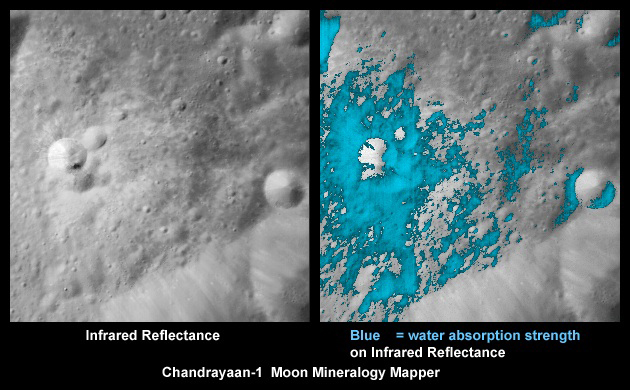
Water has been discovered on the surface of the Moon. Chandrayaan-1's Moon Mineralogy Mapper radios back that parts of Moon's surface absorb a very specific colour of light which are identified previously only with water. But there is no clue of what amount of water or what form exists there. A fascinating clue being debated is whether the water signal rises and falls during a single lunar day. If true, the signal might be explainable by hydrogen flowing out from the Sun and interacting with oxygen in the lunar soil. This could leave an extremely thin monolayer of water, perhaps only a few molecules thick. Some of the resulting water might subsequently evaporate away in bright sunlight. Pictured above, the area near a crater on the far side of the Moon shows a relatively high abundance of water-carrying minerals in false-color blue
18 December 2008
Picture Of The Month - December 2008

This is not a very clear image but it is an astonishing one of the crescent Moon and Venus. This was viewed right here at Chennai on May 21st, 2004. It may be old but I would never forget this incident where the Moon forms a magical lamp with Venus brightly light at the end. This image was published in "The Hindu" on the next day. Ever since I started this blog I wanted to post this image but I never found it. By mere luck I found the old newspaper with this image and using its date I found the image in "The Hindu" website. I now hold the newspaper cutting (where the image is clear) as a possession. Click Here to read the article.
A Halo!
I remember my friend Kavin, who use to ask me repeatedly, "What is an Halo and how it is formed?". I had no answer to this question except that I knew it occurs quite regularly. So finally I decided to check on what an Halo is, and this is what I found.
Halos are nothing but a dim circle of light that is formed around the Sun or the Moon or any bright source of light for that matter (eg. a street lamp). These halos are formed due to ice crystals that are found in the clouds. These ice crystals acts as a lens reflecting and refracting the light.
 A picture of the Sun's Halo
 A Moon Halo
Halos are nothing but a dim circle of light that is formed around the Sun or the Moon or any bright source of light for that matter (eg. a street lamp). These halos are formed due to ice crystals that are found in the clouds. These ice crystals acts as a lens reflecting and refracting the light.
 A picture of the Sun's Halo
 A Moon Halo
9 December 2008
Images Of Venus-Jupiter-Moon Smile
Here are some of the images of the Smile created by Moon, Venus and Jupiter in the sky on 1st December, 2008. Venus and Jupiter forms the eyes and the crescent Moon forms the mouth. The brighter eye to the left is Venus and the one of the right is Jupiter.
 The beautiful sky smile over the city of New York.
 Through the clouds.
 Close-up Shot
 It looks perfect here.
 This image is hours after the smile. Moon has moved past Venus and Jupiter.
 The beautiful sky smile over the city of New York.
 Through the clouds.
 Close-up Shot
 It looks perfect here.
 This image is hours after the smile. Moon has moved past Venus and Jupiter.
30 November 2008
Venus Jupiter Conjunction
Have a look at the west after sunset tomorrow, December 1st, 2008. You can see the three brightest objects of the night sky very close to each other. The crescent Moon, the goddess of love - Venus, and the king of the planets - Jupiter, are all close together forming a triangle between them. Venus and Jupiter move very close to each other which is called 'Conjunction'. Venus and Jupiter will only be 2 degrees apart.
 The above picture is an illustration of the conjunction between Venus and Jupiter and the triangle with the Moon. In India, it can be viewed after sunset and not at 9pm.
Venus is very bright, its magnitude being -4.02 (Lesser the magnitude, brighter the object). Venus can sometime reach the magnitude of -4.6. With the rest of the sky consisting of faint stars, the triangle between the three brightest objects of the night sky will be eye-catching.
 The above picture is an illustration of the conjunction between Venus and Jupiter and the triangle with the Moon. In India, it can be viewed after sunset and not at 9pm.
Venus is very bright, its magnitude being -4.02 (Lesser the magnitude, brighter the object). Venus can sometime reach the magnitude of -4.6. With the rest of the sky consisting of faint stars, the triangle between the three brightest objects of the night sky will be eye-catching.
18 November 2008
Chandrayaan's First Video
Here is the first video of the Chandrayaan Mission. This video was taken by Moon Impact Probe (MIP), a payload of Chandrayaan - I which had a crash landing on the Moon on November 14th, 2008. MIP took images of the moon as it was descending down to the surface. The 15,000 frames generated by MIP during its 25 mins journey to the moon's surface was decrypted and the complete video is yet to be created. Here is a 2 min part of the video.
15 November 2008
Picture Of The Month - November 2008

Here is a colourful, close-up picture of the Moon taken by Moon Impact Probe (MIP), which is one of the 11 payloads of Chandrayaan-I. MIP was ejected by Chandrayaan on November 14th and had a crash landing (as planned) on the Moon at around 8:31 pm IST. MIP took this picture on its way to the surface of the moon. MIP (with the tri-coloured flag painted on its sides) landed on the Moon, making India the fourth country to make a physical contact on the Moon.
6 January 2008
Picture of the Month - January 2008

This is a spectacular image of a waning crescent Moon and Jupiter, which is seen at the bottom right of the image. The four sources of light around Jupiter are its four bright satellites namely - Ganymede, Callisto, Europa and Io. These satellites are known as the Galilean satellites as it was discovered by Galileo when he looked up at Jupiter for the first time in his newly formed telescope. The satellites can be seen clearly even through a small telescope.
26 August 2007
Picture of the Month - August 2007

Realize what it is? Well, here is what the Earth looks like during a solar eclipse. This photograph was taken from the Mir Space Station during August 11th, 1999 solar eclipse. The shadow of the Moon (dark part) moves across the Earth at nearly 2000 km per hour. Only observers near the center of the dark circle see a total solar eclipse. Others see a partial eclipse where only part of the Sun appears blocked by the Moon. There are two bright spots on the upper left which are possibly Jupiter and Saturn (which is not proved yet).
12 July 2007
Picture of the Month - July 2007

This is one of the rarest image I have ever seen. Well, I guess you can't see anything other than the blue sky with some clouds in it. Click on the picture for a clear view. You can see a very thin crescent Moon and a crescent Venus next to it. Click here to know more about the 'Phases of Venus'. Both Moon and Venus are bright enough to be seen in the daylight (few minutes before sunset). This image was taken at Budapest, Hungary. Few minutes after this photograph was taken the Moon eclipsed the planet.
13 June 2007
Picture of the Month - June 2007
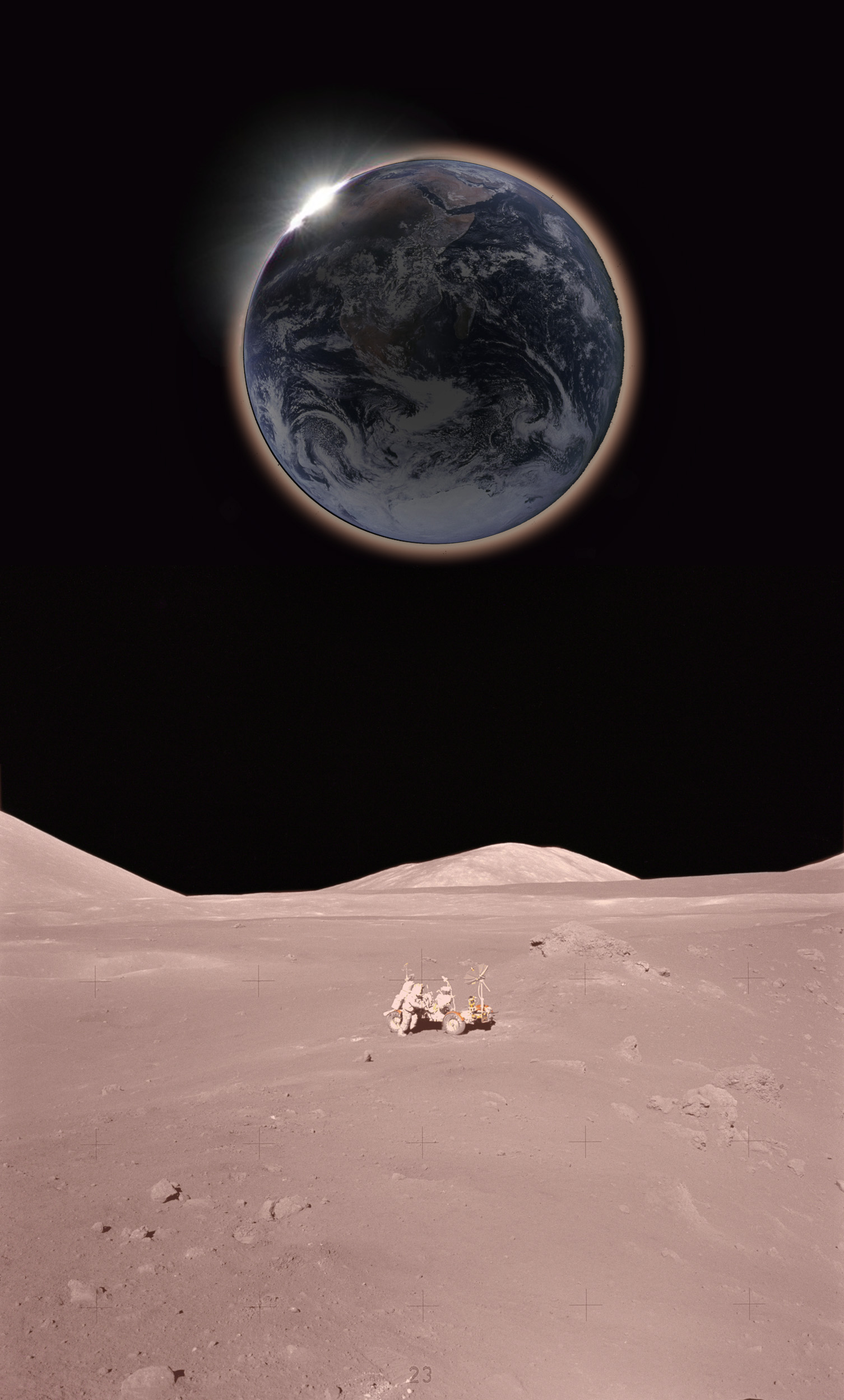
Here's another interesting picture I found on the net. This picture is a fusion of two images. One is the visit of Apollo17 to our satellite and the other is a picture of the Earth. It is fused in such a manner that it looks like Earth is eclipsing the Sun or it is the Solar Eclipse observed in Moon. This picture tries to explain that eclipses not only occur in Earth but in any planets or satellites in our solar system. When Earth comes in between Sun and the Moon, solar eclipse can be observed on Moon whereas it would be a Lunar Eclipse on Earth.
Unlike the solar eclipse on Earth, when you observe the same event on Moon you would find that Earth completely blocks the sun. The Night Earth would be visible in this case as the reddened Moon (total lunar eclipse) reflects the light.
This picture simply tells us that this is how a Solar Eclipse would be viewed from Moon.
Unlike the solar eclipse on Earth, when you observe the same event on Moon you would find that Earth completely blocks the sun. The Night Earth would be visible in this case as the reddened Moon (total lunar eclipse) reflects the light.
This picture simply tells us that this is how a Solar Eclipse would be viewed from Moon.
6 May 2007
The Secrets of Mars
Mars – named after the Roman God of War – is the fourth planet in our solar system. It has two natural satellites revolving around it - Phobos and Deimos.
 This picture shows Mars along with its two satellites Phobos and Deimos with Sun behind the Mars

Phobos has a unique property. It moves very close of the planet; it moves approximately at a distance of 9380 km away from Mars. Phobos also orbits at a very high velocity such that the time tak en for Phobos to make one revolution around Mars is quicker than the time taken for Mars to make one rotation around its axis. Due to this Phobos appears to rise in the west and set in the east unlike any other satellites in our solar system. Also due to the high velocity Phobos rises and sets twice in one Mars day (which is also aprrox. 24 hrs.) This makes Phobos a unique satellite in our solar system.
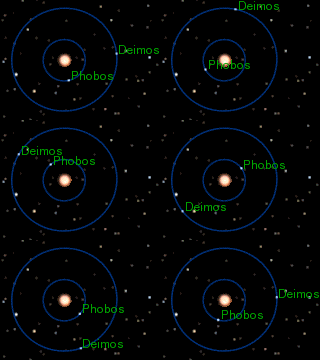
The above picture shows the orbital motion of the two satellites of Mars.
This picture shows Mars along with its two satellites Phobos and Deimos with Sun behind the Mars

Asteroids are tiny pieces of rocks which are found in between the orbit of Mars and Jupiter which orbits the Sun. The picture below shows the Asteroid belt. Phobos and Deimos escaped from their orbit and they were captured by the strong gravitational force of Mars. Thus Phobos and Deimos were forced to orbit around the Mars.

Phobos has a unique property. It moves very close of the planet; it moves approximately at a distance of 9380 km away from Mars. Phobos also orbits at a very high velocity such that the time tak
 en for Phobos to make one revolution around Mars is quicker than the time taken for Mars to make one rotation around its axis. Due to this Phobos appears to rise in the west and set in the east unlike any other satellites in our solar system. Also due to the high velocity Phobos rises and sets twice in one Mars day (which is also aprrox. 24 hrs.) This makes Phobos a unique satellite in our solar system.
The above picture shows the orbital motion of the two satellites of Mars.
Subscribe to:
Posts (Atom)