I found this video online that visually explains gravity. There are several such videos which explains why two objects with mass has gravity between them. What's fascinating in this video is that it not only explains the gravitational pull, but also the orbit of smaller objects around the larger objects, the elliptical orbit that planets take, the anti-clock-wise revolution of all planets around the sun (except of course Venus), and many more. The best part of this video is that it is not explained in computer graphics but explained practically. Watch and enjoy.
Showing posts with label Stars. Show all posts
Showing posts with label Stars. Show all posts
14 December 2014

19 August 2012
Evolution of Stars

The above image is the simplest explanation of the life of a star. How they are born or created from a stellar cloud and how they end up as a White Dwarf or Neutron Star or a Black Hole. Our Sun is a small star and hence it will end up as a White Dwarf.
Check out my other post for more details.
Life of a Star
Black Hole
Supernova
15 August 2010
Picture of the Month - August 2010

The above picture is taken during a Total Solar Eclipse. A strange shadow of darkness can be seen around the sun. This is called as Shadow Cones and they are visible due to the scattering of sunlight in the atmosphere. Shadow Cones are particularly dramatic when the eclipse is near the horizon. The above picture of Shadow Cone was taken last month from Patagonia, Argentina along with the background of Andes Mountains.
15 April 2010
Picture of the Month - April 2010
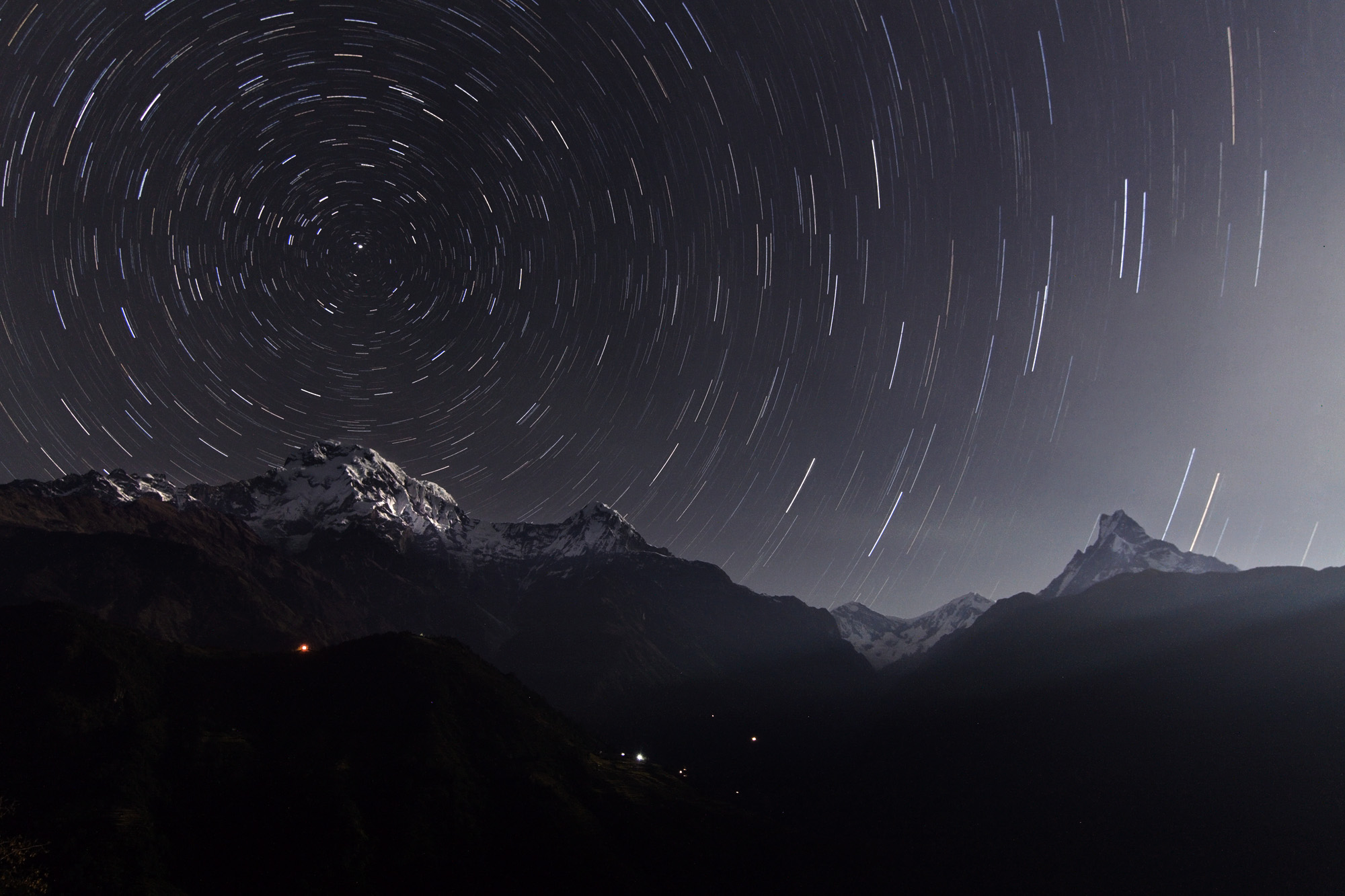
Another Startrail image taken along with the view of Annapurna ranges, Himalayas. This trail was taken during the entire day showing the complete Earth's rotation. Using this trail, the celestic North Pole can be identified, the center of the concentric trails. Also Polaris, the north star can be identified which is the bright one very near the center.
15 March 2010
Picture of the Month - March 2010
19 December 2009
Picture of the Month - December 2009

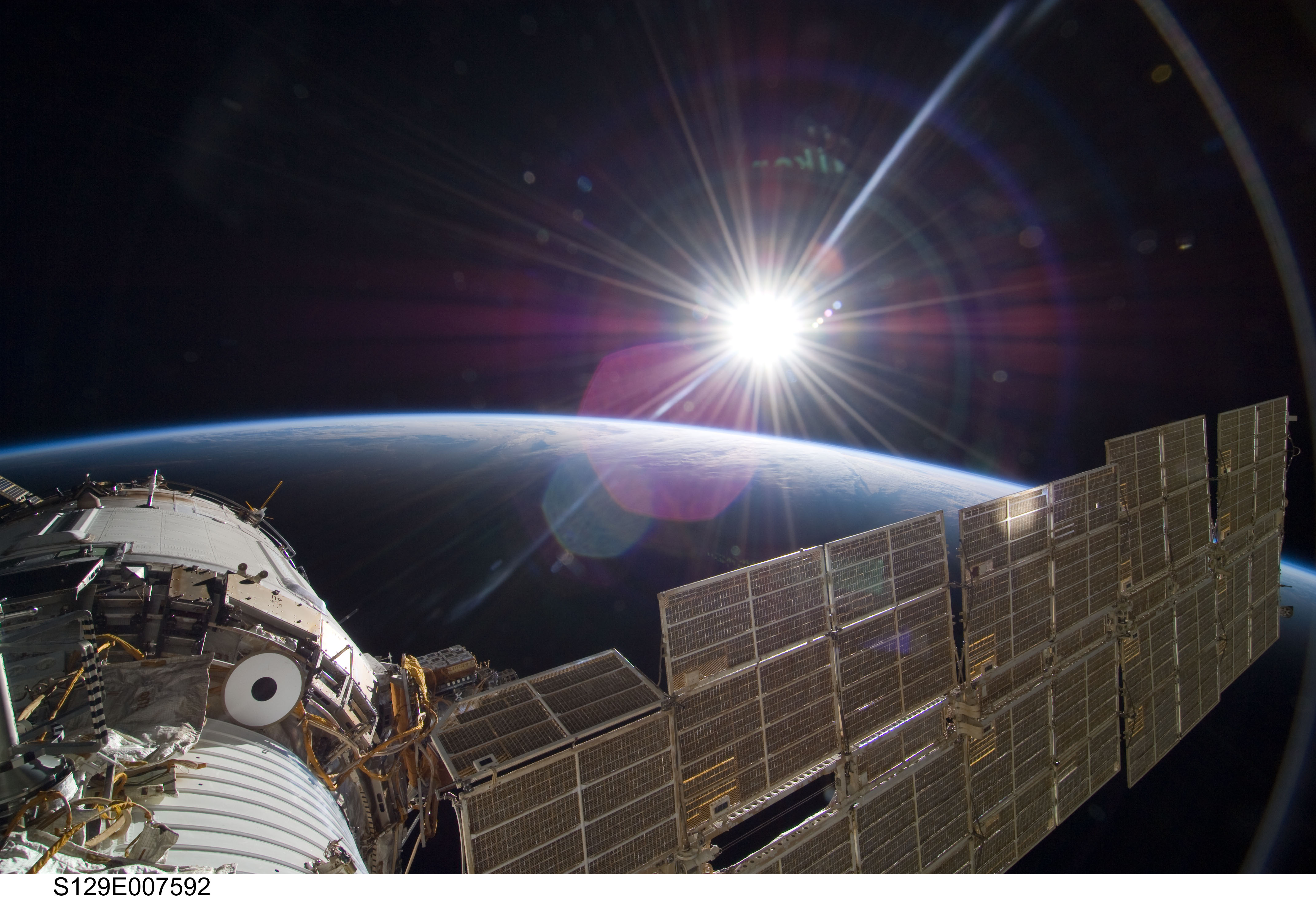
Most of you would be familiar with the star trail images. Well, its just a photograph of the sky with the shutter opened for hours so that it can capture the trail or the movement of the stars. This image also shows the trail of the moon (you can easily guess) and also Jupiter (the bright trail very near the moon). This image also shows that the stars get dimmer as it reaches the horizon. That is because of the greater air masses at the horizon.
30 November 2009
Supernova
Supernova (Supernovae in plural) is a Stellar Explosion (explosion of a star) which are so bright that it can be clearly seen even during the day time for months. Every star is made up of Hydrogen atoms. Just like how humans convert oxygen to carbon-dioxide in the process of breathing, similarly stars convert their Hydrogen atoms to Helium. When all the hydrogen atoms in the star has been converted, it will no longer be able to resist the gravity trying to compress the mass into its core. The star collapses and the outer layer is exploded resulting in Supernova. Not all stars ends in a Supernova.
Stars with a mass of more than 6 times the mass of the Sun ends up in a supernova explosion and the stars with lesser masses (including the Sun) ends up as a White Dwarf. A white dwarf radiates the remaining heat through out the universe for billions of years.
As the outer layer of the star explodes, the core of the star collapses either as a Neutron Star. If the mass of the remnant is large, it ends up into a Black Hole.
The last supernova in the Milky Way was recorded in the year 1604 called Kepler's Supernova (SN1604) which was brighter than all stars and planets. There hasn't been a supernova recorded in our galaxy since then but many were recorded in the nearby galaxies.

Supernova is classified based on absorption lines of chemical elements. But it gets too scientific and so I don't want to go into it.
On June this year, astronomers noted that a star 'Betelgeuse' (one of the brightest stars in the night sky), in the constellation of Orion has shrunk 15% since 1993 at a very high speed. It is one of the largest known stars (Red Supergaint). There is a possibility that the star has already had a supernova explosion. Since it is around 600 light years away, we could see the explosion only 600 years after it has really occured. The explosion maybe expected anytime within the next 50 years atleast. The explosion will be the largest ever recorded and it may be as large as the moon. Betelgeuse will end up into a black hole due to its huge mass. Unlike certain theories this explosion will not cause any problem to Earth.
Post requested by Sidhu
Stars with a mass of more than 6 times the mass of the Sun ends up in a supernova explosion and the stars with lesser masses (including the Sun) ends up as a White Dwarf. A white dwarf radiates the remaining heat through out the universe for billions of years.
As the outer layer of the star explodes, the core of the star collapses either as a Neutron Star. If the mass of the remnant is large, it ends up into a Black Hole.
The last supernova in the Milky Way was recorded in the year 1604 called Kepler's Supernova (SN1604) which was brighter than all stars and planets. There hasn't been a supernova recorded in our galaxy since then but many were recorded in the nearby galaxies.

This is a false-color composite of Kepler's Supernova
Supernova is classified based on absorption lines of chemical elements. But it gets too scientific and so I don't want to go into it.
On June this year, astronomers noted that a star 'Betelgeuse' (one of the brightest stars in the night sky), in the constellation of Orion has shrunk 15% since 1993 at a very high speed. It is one of the largest known stars (Red Supergaint). There is a possibility that the star has already had a supernova explosion. Since it is around 600 light years away, we could see the explosion only 600 years after it has really occured. The explosion maybe expected anytime within the next 50 years atleast. The explosion will be the largest ever recorded and it may be as large as the moon. Betelgeuse will end up into a black hole due to its huge mass. Unlike certain theories this explosion will not cause any problem to Earth.
Post requested by Sidhu
30 July 2009
Sun Dog
I had mentioned in my previous post about Sun Dog, which is a type of an ice halo. Click Here to read my post on Halo.
A Sun Dog is a particular type of ice halo. It is a colored patch of light to the left or right of the sun, 22 (or more) degrees distant and at the same distance above the horizon as the sun. It is the most commonly or second most commonly seen of the ice halos. Sun Dogs can be seen anywhere in the world during any season. They are best seen and at their most conspicuous when the sun is low. They are not rainbows.
These Sun Dogs are commonly mistaken for the Planet Nibiru.
Here are some of the pictures of the Sun Dog.


A Sun Dog is a particular type of ice halo. It is a colored patch of light to the left or right of the sun, 22 (or more) degrees distant and at the same distance above the horizon as the sun. It is the most commonly or second most commonly seen of the ice halos. Sun Dogs can be seen anywhere in the world during any season. They are best seen and at their most conspicuous when the sun is low. They are not rainbows.
These Sun Dogs are commonly mistaken for the Planet Nibiru.
Here are some of the pictures of the Sun Dog.


18 December 2008
A Halo!
I remember my friend Kavin, who use to ask me repeatedly, "What is an Halo and how it is formed?". I had no answer to this question except that I knew it occurs quite regularly. So finally I decided to check on what an Halo is, and this is what I found.
Halos are nothing but a dim circle of light that is formed around the Sun or the Moon or any bright source of light for that matter (eg. a street lamp). These halos are formed due to ice crystals that are found in the clouds. These ice crystals acts as a lens reflecting and refracting the light.
 A picture of the Sun's Halo
 A Moon Halo
Halos are nothing but a dim circle of light that is formed around the Sun or the Moon or any bright source of light for that matter (eg. a street lamp). These halos are formed due to ice crystals that are found in the clouds. These ice crystals acts as a lens reflecting and refracting the light.
 A picture of the Sun's Halo
 A Moon Halo
28 December 2007
Black Holes
If you had read my article on ‘The Life of the Star’, you would have known that a Black Hole is created when a huge and massive star (more than 2.5 times the mass of the sun) runs out of hydrogen and collapses into a Supernova explosion. If the core of the star remains the explosion it becomes a black hole. But what exactly is a Black Hole? Why is it different from other dead stars?
 This image shows how a Black Hole may look like in the Milky Way.
When such a massive star is crushed into a smaller volume, the gravitational attraction of the star increases and hence the escape velocity. The gravitational attraction of a Black Hole is very high that it pulls out anything that is closer to it. The escape velocity of a Black Hole is more than the velocity of light i.e. an object in a Black Hole should travel faster than the speed of Light to escape the gravity of Black Hole. And hence even light cannot escape its gravity. Eventually nothing can escape out of a Black Hole as nothing can travel faster than light. This is the same reason that the Black Hole is invisible. You can only see an object when it reflects light. But since Black Hole does not reflect light it is invisible.
NOTE: None of the images of the Black Holes are real. They are artistic works to show how a Black Hole may look like. A Black Hole can not be photographed. It can only be detected.
There are three types of Black Holes – Stellar Black Holes, Supermassive Black Holes and Miniature Black Holes.
There are three types of Black Holes – Stellar Black Holes, Supermassive Black Holes and Miniature Black Holes.
A Stellar Black Hole is a Black Hole created by a single star as explained above. It can be seen in almost every other galaxy.

This is an image of a Stellar Black Hole.
A Supermassive Black Hole is a Black Hole whose mass is between 105 and 1010 times the mass of the sun. It is known that most of the galaxies, including the Milky Way contains a Supermassive Black Hole in the center. It could have formed when a Stellar Black Hole start growing by pulling stars of huge mass by means of gravity. Supermassive Black Holes are only found in the center of the galaxy.
Image of a Supermassive Black Hole.
A Miniature Black Hole has not been identified but some theories say that Miniature Black Holes might have formed a short while after the Big Bang.Questions may arise such as ‘How a Black Hole was discovered if it is invisible?’ and ‘Who discovered the first Black Hole?’ Here are the answers.
Before answering them let me explain about Binary Star System. A binary star system consists of two stars very close to each other and also moves around each other. Most of the stars we see in the night sky are binary stars though it looks like one twinkling star. Sirius, the brightest star in the sky is a binary star. Sirius A is bigger and brighter than Sirius B which can be seen only through a telescope. Sun, of course is a single star. Distance between two binary stars may be about 20 to 50 times the distance between Sun and Earth. But the distance between two single stars will be in Light years.

Image of Sirius A (bright one) and Sirius B (smaller one above it).
Consider a binary system of stars where one of the stars is a black hole and the other a normal star. If the normal star's envelope gets close enough to the black hole, then the fierce gravity of the black hole can rip out gas from the normal star which is then swallowed by the black hole.
However, due to the conservation of angular momentum, the gas cannot plunge straight into the black hole, but must orbit it for some time before it gets sucked. Thus, a disc like structure is formed around the black hole from which gas is pulled slowly into the black hole. When the gas orbits the black hole in the disc, its temperature is raised to several millions of degrees which emits radiation in the X-ray part of the spectrum (by the first note that I explained above). Thus, when we detect X-ray sources in the sky, then we know that there is gas which has been heated to several million degrees, and one of the mechanisms to achieve that is the accretion disc around the black hole. Now about actual discovery: In the early 1970s, an intense X-ray source was found in the constellation Cygnus called Cygnus X-1. As the years passed, in the 1972, Cygnus X-1 was identified with a star known by its classification number HDE226868 (which is a radio source). Soon evidence was found that it is a binary star system with a period of about 5.6 days.
By the special Theory of Relativity, no information can travel faster than the speed of light. Hence, a celestial object cannot change its luminosity on a time scale shorter than the time taken for the light to reach from one side of it to the other. Analysis of Cygnus X-1 showed that its emission had luminosity variations on time scales as short as thousandths of a second, suggesting that the object was only a few kilometers wide. Thus evidence was found that one of the stars was a compact object. Finally, astronomers used the binary star system to determine the mass of the compact object and found that it was greater than the critical mass, so that it was most likely a black hole. That is about the discovery of the first black hole in our universe.
16 December 2007
The Life of a Star
What is a Star? A star is a hot body of glowing gases that emits light and undergoes nuclear reaction. This is the only difference one can point out between a star and a planet. There are billions and billions of stars found in our galaxy, The Milky Way. There are thousands of galaxies in the Universe. It is said that there are more stars in the universe than the number of grains of sand found in all the beaches of the Earth. It is predicted that there are 100 billion stars in the Milky Way. Stars vary in their size, mass, temperature, density, etc. No two stars are alike just as no two humans are alike (left alone the identical twins). But yes, the stars do look alike as you watch them in the night but if you watch them carefully you can see that some stars are bright and some are comparatively less bright.
Stars, just like life, have birth and death of its own. Stars live for a period of time and then it dies. By saying stars I also include the Sun. At average stars live upto 10 billion years. Let’s see how a star is born.
Birth of a Star:
Usually a star is born in a region of high density Nebula. Nebula is nothing but a cloud of dust in the space in which stars and planets are born. Nebulae are visible to our naked eye as a tiny coloured patch of light. The Orion Nebula is one of the brightest nebula situated in the Orion Constellation.
Stars, just like life, have birth and death of its own. Stars live for a period of time and then it dies. By saying stars I also include the Sun. At average stars live upto 10 billion years. Let’s see how a star is born.
Birth of a Star:
Usually a star is born in a region of high density Nebula. Nebula is nothing but a cloud of dust in the space in which stars and planets are born. Nebulae are visible to our naked eye as a tiny coloured patch of light. The Orion Nebula is one of the brightest nebula situated in the Orion Constellation.

The picture above shows the orion nebula at the bottom left and horse head nebula at the top right. This nebulae is found in the constellation of Orion.
When the nebula condenses and contract under its own gravity it creates a new star. The region of condensing matter will begin to heat up and it starts to glow. These glowing bodies are called as protostars.

The above picture shows a protostar in a nebula. The x-ray version does not show the protostar but you can clearly see them in an Infrared version of the image.
When a protostar contains enough matter the central temperature reaches 15 million degrees centigrade. At this temperature nuclear reactions starts where Hydrogen fuses to form Helium. The star then begins to release energy stopping it from contracting. Now it is called as Main Sequence Star. Sun is in Main Sequence Star level. A star is said to be in its Main Sequence Level for 10 billion years before it starts to die. Sun is said to be 5 billion years old and it is said to live for 5 billion more years.
Death of a Star:
A star is considered dead when all the hydrogen is burnt into helium. But what happens to a star after its death? There are two possibilities based on their mass.
Mass of the Star is under 1.5 times the mass of the Sun:
If the mass of the star is less than 1.5 times the mass of the Sun then as the hydrogen gets less the star begins to expand. The expanding star is called as a Red Giant.

The above picture shows the size comparison of a Red Giant with the Sun and the Earth.
The helium core runs out, and the outer layers drift of away from the core as a gaseous shell, this gas that surrounds the core is called a Planetary Nebula.

The picture above shows the Boomerang planetary nebula where a shell covers around a star.
The remaining core (that’s 80% of the original star) is now in its final stages. The core becomes a White Dwarf the star eventually cools and dims. Sirius, the brighest star in the sky is a White Dwarf. When it stops shining, the now dead star is called a Black Dwarf.
The picture below shows the white dwarfs which are circled.

Mass of the Star is greater than 1.5 times the mass of the Sun:
If the mass of the star is greater than 1.5 times the mass of the Sun then as the hydrogen gets less the star begins to expand just as the previous case. But here the star becomes massive in size and it is called as a Red SuperGiant.

The above picture is a size comparion of a Red SuperGiant Aldebaran with the Sun.
The SuperGiant then starts of with a helium core surrounded by a shell of cooling, expanding gas. In the next million years a series of nuclear reactions occur forming different elements in shells around the iron core. The core collapses in less than a second, causing an explosion called a Supernova, in which a shock wave blows of the outer layers of the star. The actual supernova shines brighter than the entire galaxy for a short time. The bright object at the top left corner (arrowed) is a supernova explosion.

Sometimes the core of the star survives the explosion. If the surviving core is between 1.5 to 3 times the mass of the sun, it contracts to become a tiny, very dense Neutron Star. If the core is much greater than 3 times the mass of the sun, the core contracts to become a Black Hole.
15 December 2007
Picture of the Month - December 2007

If you take a picture of the Sun at the same time each day for a year, would it remain in the same position? The answer is no.
The shape traced out by the Sun over the course of a year is called an Analemma. The Sun's apparent shift is caused by the Earth's motion around the Sun when combined with the tilt of the Earth's rotation axis. Earth does not move around the Sun in a perfect circle. The Earth's orbit is rather elliptical. So at some part of the year Sun is closer to the Earth and at some part it is farthest. Earth's axis is tilted at an angle of 23° which gives out seasons. During summer the Sun will appear at its highest point of the analemma and lowest during winter.
Analemmas created from different Earth latitudes would appear at least slightly different, as well as analemmas created at a different time each day. The analemma pictured on top was built up by Sun photographs taken from 1998 August through 1999 August from Ukraine. The foreground picture from the same location was taken during the early evening in 1999 July.
26 August 2007
Picture of the Month - August 2007

Realize what it is? Well, here is what the Earth looks like during a solar eclipse. This photograph was taken from the Mir Space Station during August 11th, 1999 solar eclipse. The shadow of the Moon (dark part) moves across the Earth at nearly 2000 km per hour. Only observers near the center of the dark circle see a total solar eclipse. Others see a partial eclipse where only part of the Sun appears blocked by the Moon. There are two bright spots on the upper left which are possibly Jupiter and Saturn (which is not proved yet).
6 April 2007
The Green Sun
Confused by the title? I'm not trying to make an April Fool here. We have indeed witnessed the Green Sun. This video of the setting Sun from a site atop Mt. Autore (altitude 1,850 meters) in Italy has captured a green flash while the Sun was setting. How can the Sun turn green? Why does it occur? When can we observe this phenomenon?

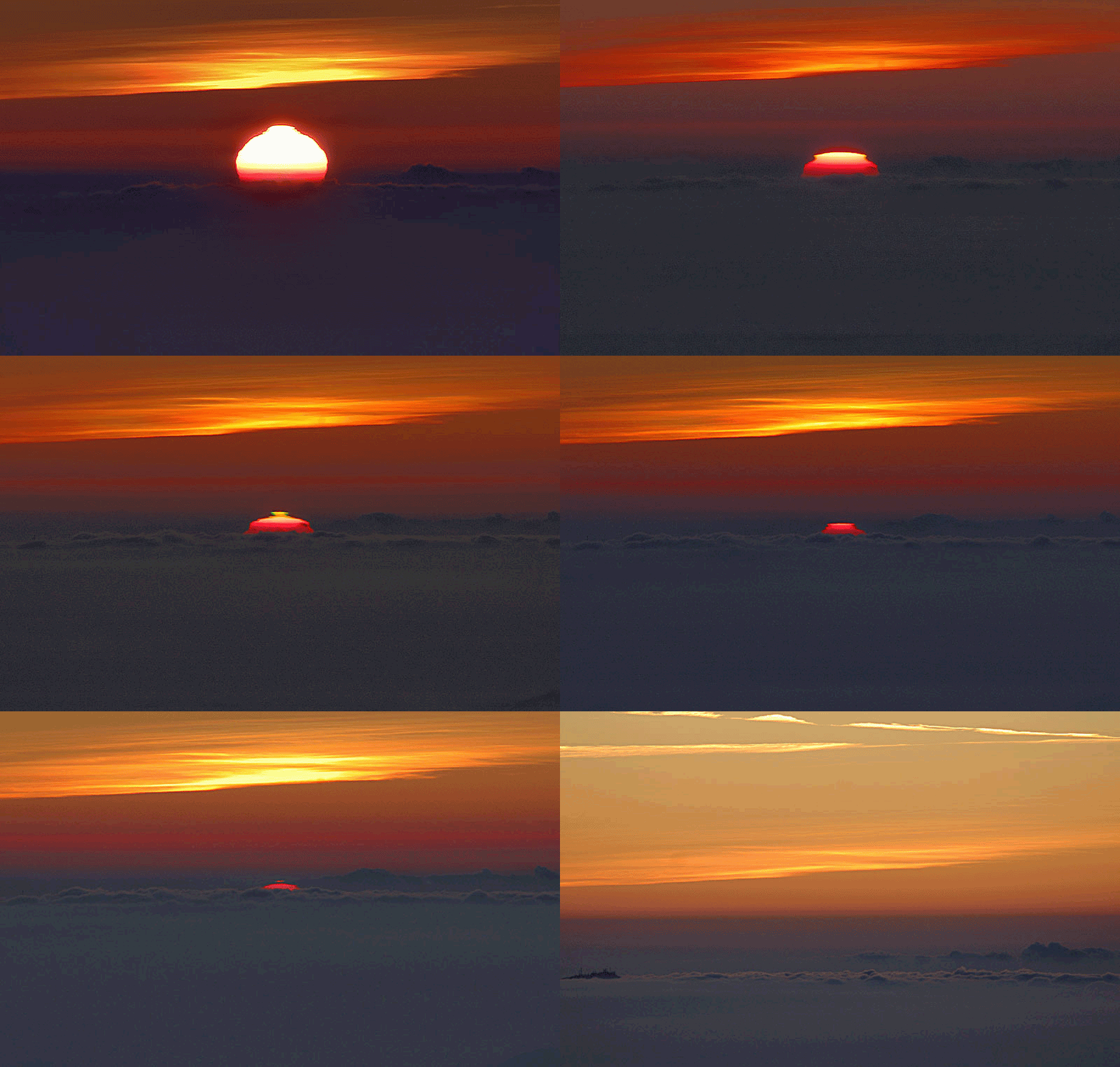

It is quite difficult to observe the Green Flash. It usually occurs during sunrise or sunset. This phenomenon is caused by the atmospheric bending or refraction of sunlight. Like a weak prism, the Earth's atmosphere breaks white sunlight into the seven colours, bending red colours slightly and green and blue colours through increasingly larger angles. When the sky is clear, a green flash just above the Sun's edge can sometimes be seen for a second or so, when the Sun is close to the horizon.

The above image was taken at the western horizon of Madagascar

This image of Green Flash was taken at the La Silla Observatory, in Chile, on October 15, 2005. The sun has almost set behind the mountain ranges of the western Chile when the Green Flash was observed.
Note: Click on the pictures for a better view.
Subscribe to:
Posts (Atom)