Showing posts with label Meteoroids. Show all posts

17 February 2013

Russian Meteorite has nothing to do with 2012 DA14


This story begins approximately a year back. In February 23, 2012, a free asteroid was discovered. It was calculated that this asteroid would travel very close to Earth on February 15, 2013. This asteroid was named 2012 DA14. This asteroid was approximately 50 meters in diameter. The asteroid was said to travel as close as 30,000 km from Earth which is closer than the Geosynchronous orbit (Orbits of Geosynchronous Satellites).

An Artistic Impression of Earth and Asteroid 2012 DA14


Trajectory of Asteroid 2012 DA14

About 15 hours before the passing of this asteroid there was a meteor event near Chelyabinsk, Russia. An object (now called Chelyabinsk Meteor) from space entered the Earth’s atmosphere thereby becoming a fireball. This object was estimated to be of a diameter of 17 meters. This object was undetected until it reached the atmosphere due to its relatively small size. This object was said to have been travelling at a speed of 108000 km/h before impact. The energy released by this meteor was said to be 500 kilotons of TNT which is 20-30 times more than that of the atom bombs of Hiroshima and Nagasaki. This energy created a shock wave which injured about 1200 people mainly due to the glass shattered from windows. Three impact sites of the meteor were found. One of the impact sites had fragments of the meteorite.


Trail left over by Chelyabinsk Meteor

NASA and ESA (European Space Agency) confirmed that the Chelyabinsk Meteor had nothing to do with the asteroid 2012 DA14. The asteroid continued to pass through about 15 hours after the event. They are still investigating on the meteor.


A video of the Meteor and the shock wave it left


15 February 2010

Picture Of The Month - February 2010


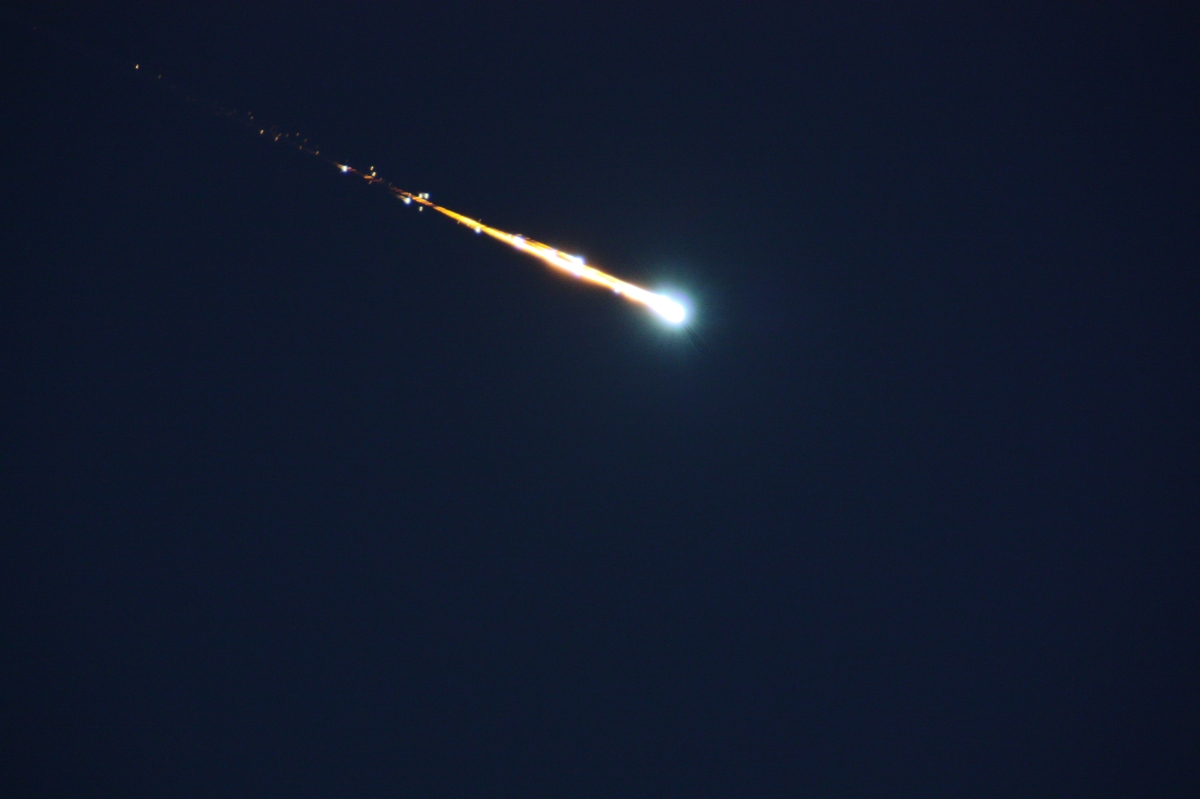
The brilliant fireball meteor, as bright as the full moon was captured in this snapshot over the city of Groningen, Netherlands on October 13th, 2009. The sightings of the meteor were widely reported throughout the Netherlands and Germany at approximately 17:00 UT. Accompanied by sonic booms and rumbling sounds, the meteor was seen to break up into bright fragments, eventually leaving a persistent smoke-like trail. Even though there are bright fireball meteors in planet Earth's atmosphere every day, sightings of them are relatively rare because they more often occur over oceans and uninhabited areas.

17 December 2008

Geminids Experience

It is the day of Geminids. I had a very long, horrible day throughout. The worst day of my entire life had a happy ending with about 5 meteors. Click here to read the experience of my day. Due to various reasons I reached home as late as 11 pm. I went straight to my terrace at around 11:15 only to find most of the sky covered in clouds. I realized that the clouds were moving very fast and within 10 mins they must clear. Just as I thought the sky was cleared in 10 mins making the sky, around Gemini, clear. The Moon was very bright and I was sure to miss out lots of meteors. I positioned myself such that I could see all around Gemini especially the western part of the sky.

11:39 - South-west, 80 deg from the horizon, a short meteor. Not the brightest.

11:48 - This one was a little to the west from zenith (exactly over-head). It was very quick and very short. It was very quick and also being short, it disappeared less than a second.

11:55 - About 60 deg from the northern horizon, moving towards west. It was a little bright and longer than the previous two.

This was when a bunch of clouds came in. Had to wait a long time for it to clear.

12:15 - About 45 deg from the western horizon. It was less bright but it was quick.

12:30 - About 60 deg from south-west horizon. This one was bright and it moved slowly, about the normal speed with all others being too quick.

The long tiring day started to take over me and I realized I almost dozed at the terrace. I decided to get back into the house and sleep. But it was a good experience.

I hope atleast one of my friends had caught one.

9 December 2008

Geminids 2008

Yet another Meteor Showers. This one is called Geminids. These meteors appear to out of the constellation Gemini, just as Leonids did from the constellation Leo. It can be viewed between December 8th till December 17. But it peaks on December 13-14.

Best time to look out for Geminids is from 9pm on December 13th till sunrise on December 14th. It peaks at about 100 meteors an hour. On non-peak days, you may only spot about 10 an hour. Geminids are one of the best shower of the year. These meteors originated in a mysterious object called 3200 Phaethon, which looks like a cross between an asteroid and a burned-out comet. Each time Earth reaches this point in space, the debris falls into the atmosphere causing the meteors.

Where to look? Look at the entire sky during the time. It can appear anywhere. Its direction would be away from Gemini. For those who feel safe to know the location of Gemini, the constellation is exactly where the moon is on December 13th. And yes! Its a full moon. The bright full moon may block most of the meteors. Hence, you can only see the bright meteors. All the dull meteors will be shunt by the bright light of the moon. So look at the entire sky, best being around the moon.

Click Here to see the position of the moon over Gemini and also how the meteors appear from the constellation. The red "X" on the picture is the radiant of the shower. Radiant is a point from where the meteors appear to move from. No meteor will be visible at the radiant. It only appears to move away from it.

23 November 2008

Bright Meteor Over Canada

A huge fireball was seen in the sky on 20th November 2008 over Edmonton, Canada. A video has been captured of this bright meteorite that fell onto Earth. Here is one of the most rarest and the latest video of a meteorite.


17 November 2008

LEONIDS' Experience

Hi. Here I am to share my experience on Leonids 2008. Well, November 17, 2008 is D-day, and here it is. Alarm was set-up at 3:00am on my mobile to start my first meteor hunt (my second actually. My first was 2005 Leonids which I was looking at a complete wrong time and hence failed).

I woke up from a dream (not a nightmare), and discovered that the time was 3:40 and the alarm was off. I didn’t know whether to call myself lucky or unlucky. Went straight to my terrace and I realized that I am, actually unlucky. It was overcast, especially the east horizon. Since the constellation Leo is said to be at the east horizon and that the meteors appear to origin from that constellation, I wasn’t really happy.

Went back downstairs and scanned through the Planetarium Software on my system to find the exact location of the constellation Leo. It was about nearly 4:10 when I decided to go back to my terrace.

I was happy that the sky was partly clear and that the clouds were moving pretty fast. I positioned myself such that I could see the east part of the sky quite clearly. I kept looking there for about 20 mins with no success. During this time I was also trying to identify the constellation Leo. All I could see was two stars near the horizon. At around 4:30 I noticed more stars at the east horizon and I realized that the brighter of the two stars was Regulus (Constellation Leo) and another bright at the dead east was actually Saturn. I decided to go back to my computer to check the planetarium software again and that was moment I would never forget for the rest of my life.

4:32 am – I spotted my first ever meteor. It was to the right of Regulus. It was moving further right away from Regulus. Yes, it was a Leonid and it was moving away from Leo. It was short compared to what I saw in youtube. And quick! Very quick! If I had attempted to blink I may not have caught it after all.

I was really excited. I was literally jumping with joy. Now I noticed that the sky is much clear. I was looking at Sirius, how bright it was; and Orion (my favorite constellation); and the Moon, was really bright. And then –

4:37 amAnother one - To the north of the Moon - Moving towards the west. Again away from Leo (Leo was still at the east). I realized that the meteor may not actually appear near the constellation. Moon was at the constellation Gemini and so was this meteor.

I ran back downstairs and woke up mom. My friend, Kavin messaged me asking if it was worth having a look. Somehow I convinced him to go to his terrace and have a try. Nearly 30 mins later my mom said she was tired and she went back. Bad Luck for her, I thought. A little while later, Kavin messaged me saying it was getting cloudy again and that he was quitting. Bad Luck for him too. I went back to my computer to confirm the location of Leo and Saturn.

Went back upstairs and by now I was really fed up. No meteors in the last 45 mins. I just turned to see if the sky was clear and again –

5:27 am – Another. My third lucky meteor! This one was a little above the north horizon, moving from east to west. Again, away from Leo! This was when I realized how wrong I was. I thought that Leonids would appear near Leo. Now I realized that it can appear anywhere in the sky. The only thing was that it appears to move away from Leo.

Now I decided to stand up and look all over the sky. I was sure I missed a lot of them when I was only looking at east. I’m not gonna miss anymore. 10 mins later I felt I saw a faint meteor near the east horizon. Bright Moon and tiny source of light at the east (rising Sun), it could have really been a meteor but I might have imagined as well.

In another 10 mins light was growing on the east. I realized that I was finding difficult to spot even Orion. All I was able to see on the sky apart from Moon was Sirius, Regulus, Rigel and Saturn. All the other stars had faded due to the growing sun light. That was when I decided to quit my first meteor hunt. Pretty successful. But that’s not the end of the story. Geminids still waiting on December.

14 November 2008

Meteoroids

This is my first post on Meteoroids and I am going to help you guys catch a Meteor Shower. In 3 days time you can catch Leonids, on 17th November, 2008. Before guiding you through that let me explain what a meteoroid is.

Meteoroids are tiny rock particles found in space. It may be broken asteroids or remains of a comet. It is smaller than asteroids and they do not have a definite orbit. When a meteoroid enters the Earth's Atmosphere it is called a Meteor. And when it hits the ground it is called a Meteorite. Smaller meteors gets burned up when it reaches the atmosphere hence not all meteors reaches the ground. Meteors are more famously called as 'Shooting Stars' or 'Falling Stars'.

A Meteor or a Shooting Star

Meteor Shower is an Astronomical Event when many meteors are observed at the same point of region in the sky on the same night. If the night sky is clear and if the moon is not too bright, you may even catch up about 50 meteors. Let us see what causes the Meteor Shower.

When a comet moves closer to the Sun, some of its ice particles and debris remains. When Earth passes through the same region in space most of the debris fall into the Earth's atmosphere causing Meteors Showers. This is an annual event. Every year when Earth passes through the same region you can notice many meteor showers.

One such Meteor showers can be noticed on 17th November. This Meteor Shower is called as Leonids. Leonids occur every mid november. As mentioned earlier all the meteors appears to come from the same point on the sky. In this case all the meteors appear to come from the constellation of Leo, hence the name. This can be easily explained by this picture.


The above picture shows the constellation of Leo and how the meteors appear to come from the same point.

So wake up very early on the morning of November 17th, and keep looking into the sky near the constellation of Leo. Use Stellarium Software to help yourself find the constellation of Leo. At an average you may spot 10 to 15 meteors an hour. Even if you cannot spot Leo, just keep looking up at the sky between 3:30 am until sunrise. You should be able to catch quite a few meteors.

NOTE: You need to be really patient if you want to catch some meteors. Hope the clouds and the Moon won't spoil the show. And the meteor can be quick that you can easily miss it. So watch carefully.


View this video to get an idea on how you actually see it. Note that this is a fast forward.

I haven't seen a Meteor yet. This is the first time I'm going to hunt for meteors. I hope I'm successful and you too.