Showing posts with label Comets. Show all posts

6 March 2013

Comet Pan-STARRS - First Look


Below is the first picture of the Comet Pan-STARRS. The Comet looks really bright and promising. The Comet is currently visible in the Southern Hemisphere during the evening after sunset. In the Northern Hemisphere, the comet is still very close to the Sun and it cannot be seen yet.

Comet Pan-STARRS illuminates the evening sky with a spectacular tail in Buenos Aires, Argentina on March 2, 2013

The Comet is expected to make an appearance in the Northern Hemisphere by March 10th. Keep your binoculars and DSLRs ready.

10 February 2013

Where to Look for Comet Pan-STARRS


Amateur Comet Hunters who do not know where to look for the Comet Pan-STARRS, I hope that this article would help you. I have taken a few screenshots with the help of online Planetarium Neave, and marked the location of the Comet.

This is the position of the Sun and the Comet on Feb 25th at about 06:00 pm. Since the altitude of the Comet is lower to that of the Sun, the Comet would not be visible.


On March 2nd, the Comet would have traveled a little higher in altitude, but it still wouldn't be visible.


On March 7th, the Comet looks to be at a good viewable altitude. Not sure if the Comet will be visible then. The first visibility of the Comet should be any day between March 7th and March 10th.


On March 12th the Comet should definitely be visible since its altitude is higher to that of the Sun. Lets hope its bright enough with a long tail and most importantly, let's hope its a clear sky.


The below illustration shows how the Comet may look like on March 12th, 16th 20th and 24th. Definitely looks promising. Make sure you enjoy this rare evening beauty throughout March.


Below is the first photograph of the Comet with a tail. This was shot in New Zealand in January.


3 February 2013

Comets of 2013


Comets are unique objects which are a part of our Solar System. They are basically asteroids which take more of a unusual orbital path around the Sun. Comets are distinguished from Asteroids by its tail. The nucleus of a Comet is made up of icy particles and they start to melt as they go close to the Sun, which forms the tail. The tail never tells us the direction of the Comet’s path but it always points away from the Sun. Not all comets have a tail. Some tails are tiny and cannot be seen. Few tails are larger than the Comet itself and few take up a weird shape.

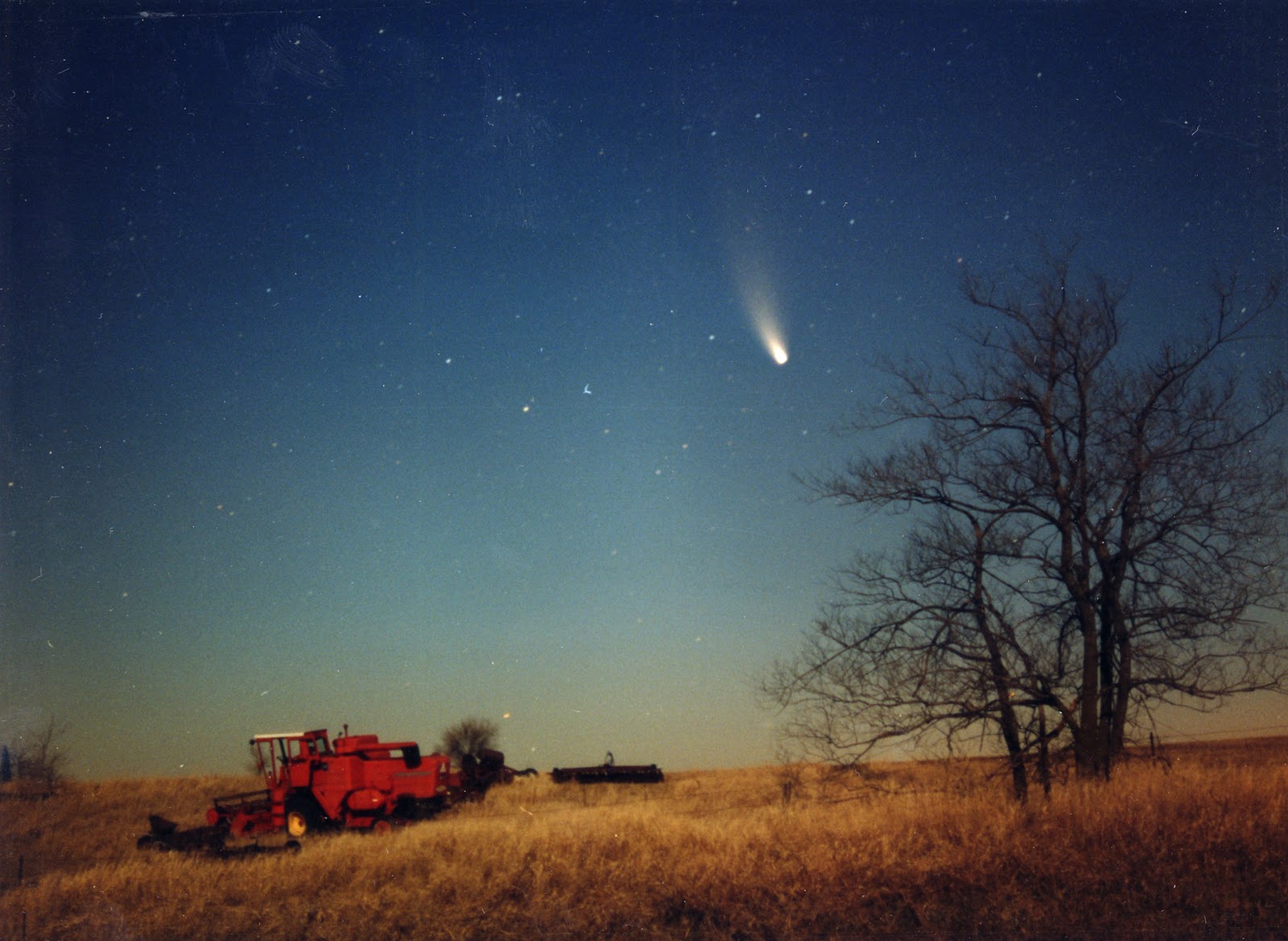
The most famous of all Comets is the Halley’s Comet which appears once every 76 years. This comet has been recorded since 240 BC until its last appearance in 1986. It is expected to appear again in 2061. The last visible appearance of a Comet was Hale-Bopp in 1997.

Comet Hale-Bopp in 1997

Comets are rare. They need to be both closer to the Earth and Sun for us to see the tail with our naked eye. Lots of Comets were discovered since Hale-Bopp but none of it made a grand appearance. But 2013 is in for a surprise.

Two Comets were discovered recently that can give out a decent appearance (at least) this year. Comet C/2011 L4 (PANSTARRS) is expected to appear bright in the evening sky in the second week of March. And Comet C/2012 S1 (ISON) is expected to appear in late November. Both these comets are expected to be bright enough to be seen by our naked eye. But a beauty of a Comet depends on its tail. So nothing can be promised until the Comet makes the appearance. Comet ISON is expected to be the Comet of the Century (just predictions) but November is still at far. Let’s keep our focus on PANSTARRS for now.

With only 4 weeks away, Comet PANSTARRS is too close to the Sun for us to see it now. We can only see the Comet in the second week of March (approx on Mar 10). Keep an eye out in the West during and after sunset. The Comet may last the entire March and April but only if it acts as it has been predicted to do. Keep your cameras ready and keep your fingers crossed.