Brilliant Venus, slender crescent Moon, and lights along the Ponte 25 de Abril, which is a 2.3 km long suspension bridge across Tagus river glow against the western twilight in this lovely Moonset scene from Lisbon, the capital city of Portugal, recorded on March 20, 2007. In fact, such serene views were enjoyed across planet Earth this week, as the young Moon remained near the setting Sun following a partial solar eclipse, and Venus ruled as the evening star. Because of strong Earthshine - light from the sunlit Earth - even the Moon's night side is clearly visible in the picture.
6 April 2007
Picture of the Month - April 2007
Brilliant Venus, slender crescent Moon, and lights along the Ponte 25 de Abril, which is a 2.3 km long suspension bridge across Tagus river glow against the western twilight in this lovely Moonset scene from Lisbon, the capital city of Portugal, recorded on March 20, 2007. In fact, such serene views were enjoyed across planet Earth this week, as the young Moon remained near the setting Sun following a partial solar eclipse, and Venus ruled as the evening star. Because of strong Earthshine - light from the sunlit Earth - even the Moon's night side is clearly visible in the picture.
5 February 2007
Picture of the Month - February 2007

28 January 2007
Goddess of Love - Venus

Venus is the brightest object because its atmosphere consists of carbon dioxide and thick clouds of Sulphuric Acids which covers the planet completely. We can never see the surface of Venus unless we go into its atmosphere. Due to this reason Venus acts as a ‘Green House’. Thus the atmosphere of Venus reflects more than 95% of the light from the sun making it the brightest object in the sky. During the early periods Venus was confused for a UFO. The bright star on the top left of the picture below is the Planet Venus. We can clearly see that Venus is very bright compared to the other stars.
Venus is one of the two Inferior Planet (the other being Mercury). Inferior planets are simply planets whose orbits are within the orbit of Earth. Since Venus is the Inferior Planet we can only see the planet near the Sun i.e. either before sunrise or after sunset. When Venus is seen in the morning before sunrise it is called as the ‘Morning Star’ and when it is seen in the evening after sunset it is called as the ‘Evening Star’.
We can see Venus through our naked eye. It looks like any other star but no star can match its brightness. When you look at the planet through a telescope you can see special phenomenon which can only be noticed by the inferior planets. But Mercury is too close to the Sun and so only Venus exhibit this character very clearly. So far this phenomenon has only been noticed in the Moon, yet it is more special in Venus. This phenomenon is nothing but the ‘Phases of Venus’. It is no different from that of the Moon. Just as Moon, Venus changes its phases from ‘New Venus’ to ‘Full Venus’ and again back to ‘New Venus’. But this effect can only be viewed through a telescope.
When Venus is behind the Sun we can see the full phase of Venus. As Venus moves through its orbit it reduces its shape into a Gibbous, just like Moon. When Venus is exactly at right angles to Sun and Earth we can see Half-Venus. And as Venus continues to move around the sun and as it comes in-between the Earth and the Sun, it reduces its shape to a cresent and finally a new-Venus, exactly as that of the Moon. Yet, there is something different in its formation of phases which makes it phenomenon. During the full phase, the Venus is usually behind the sun and hence it is smaller in size due to the longer distance from the Earth. But during the cresent, Venus comes in-between Sun and Earth and hence it appears larger in size. So as Venus goes around the Sun it not only changes its shape but also its size. This phenomenon could also be seen in Mercury but to a small extent.
The picture below shows the different phases and the sizes of Venus during April-May 2004.
When Venus is exactly in between in the orbit of Earth and Sun we can see its Transit. Transit of Venus is nothing but the movement of Venus on the surface of Sun. We can see Venus as a dark spot on the sun. The picture below shows the transit of Venus over the surface of Sun. The dark spot on the Sun in the left is Venus.
The first person to notice the Phases of Venus is Galileo Galilei with his newly invented telescope. We can now see Venus at this very day as the ‘Evening Star’. We can see the planet clearly with our naked eyes. It looks just like a star but look for the brighest in the west. It is so bright that you can see the planet even before it gets dark completely. The planet will be visible until an hour or so after sunset.
If you want to look at the phases of Venus go to a planetarium nearby.
3 January 2007
Picture of the Month - January 2007

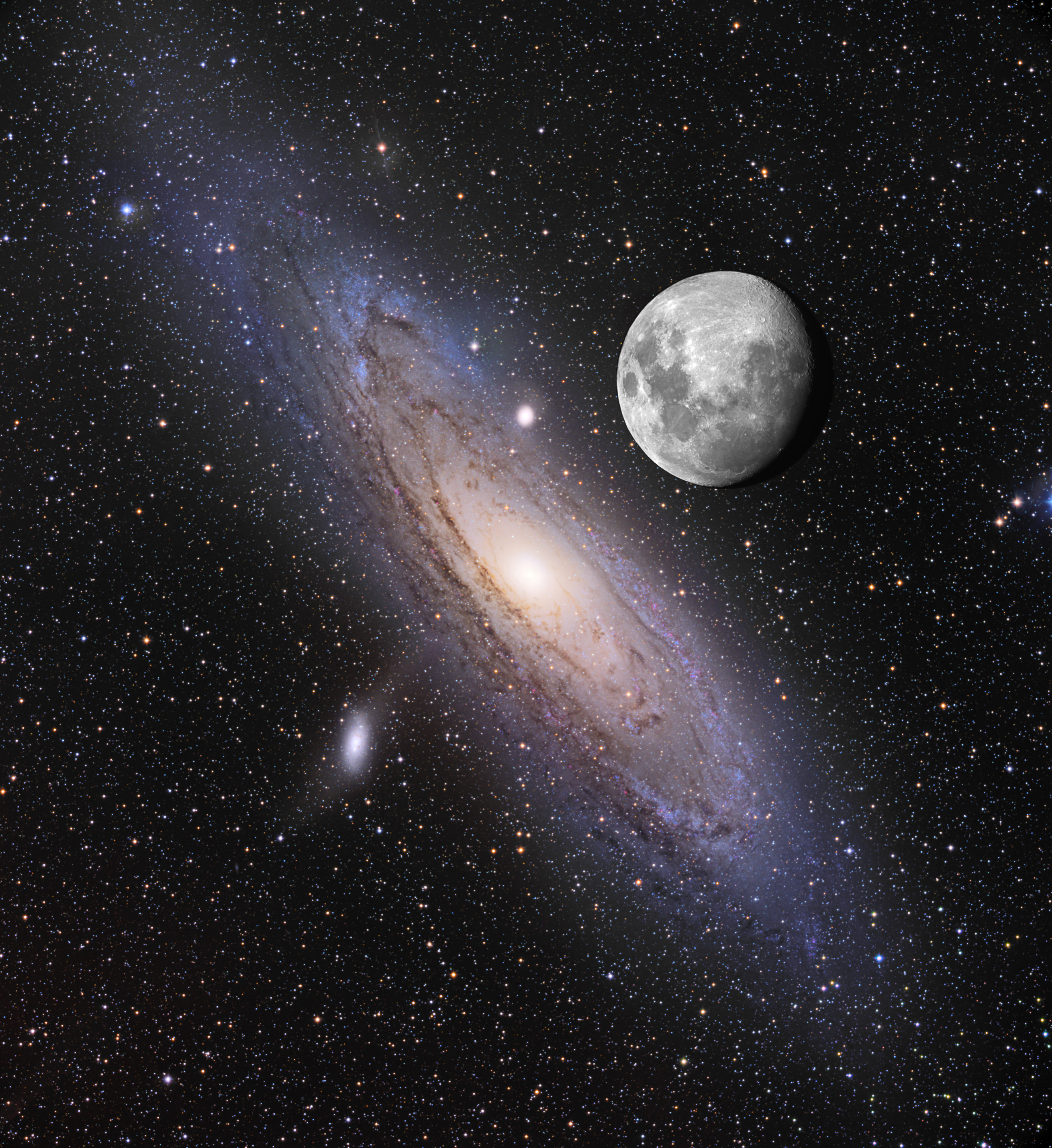
This picture shows the full moon with Andromeda Galaxy(aka M13) in the background. This galaxy is only about 2.5 million LY (Light Years) away and it is known as the closest spiral galaxy to Milky Way. This entertaining image compares the zoomed in image of the galaxy and the normal sized image of the mooon with the same angular view. In the normal view this galaxy looks like a small, faint, fuzzy patch near the constellation of Andromeda.
28 December 2006
How old is Everything?
The topic I’m going to discuss is ‘How old is Everything?’ and by saying ‘Everything’ I mean the ‘Universe’.

No one is sure of the age of the Universe, for no one knows how it began. Some say it’s the ‘Big Bang’ and some say it is the ‘Steady State’. In fact there are many more theories put forward to explain the origin of the Universe. But there is no proof for any of the theories but Big Bang has more evidences. The only way to find out when the Universe originated is by moving back in time. We are slowly going to move back in time and see if the Universe existed at that point of time. So let’s get to it.
Universe certainly existed 4000 years ago as we do have some proof of human civilizations in Earth. The best example is Indus Valley Civilization and Egyptian Civilization. But no one knows what had been before that. Discovery of Jurassic bones helped us move a little further. These bones were tested and they were found to have lived about 2000 million years ago. And so we can certainly say that Earth did exist 2000 million years ago.
Some of the rocks on this planet were tested by scientists and they found some of the oldest rocks on the surface of the Earth. These rocks were found to be billions of years old. The oldest rock ever found was nearly 4.5 billion years old. That could be the time when Earth had formed or much before that. We could not find anything older than that and so we assume that Earth is actually 4.5 billion years old. Some scientists believe that the Earth was formed along with the other members of the solar system including the Sun. And so they think that our Solar System is also 4.5 billion years old.
We have some how estimated the age of the Earth but what about the Universe? How can we find out the age of the Universe? We can not take any samples from other stars to tests its age. It is merely impossible to reach other stars. Are there any other methods to find the age of the stars without reaching it?

The age of some of the stars can be found by testing the magnitude or intensity or the brightness of the star. By calculating the magnitude of the star, the amount of Hydrogen that has been burnt in the star can be estimated. With the help of this we can estimate the time when the star will die and also when it was born. Using this method the scientists have found that Sun has a life span of 10 billion years will die in another 5 billion years. This is very close to our assumption of the age of the Earth. So the solar system must be around the age to 4.5 to 5 billion years. The magnitude of the stars from some of the Globular Clusters were calculated. A Globular Cluster is a collection of stars which are bound by gravity. Most of the stars in a globular cluster are old. The above picture shows the Globular Cluster M13 found in the constellation of Hercules. The age of the stars in various clusters was estimated and it was found that the oldest globular cluster was around 11 to 18 billion years old. This is the lowest limit of the age of the Universe we could ever estimate from the stars. Scientists are still trying out various experiments to extend this limit. As of now the age of the Universe is 11 to 18 billion years old.
This information has been acquired from the net. If you have any further doubt or any questions about this topic you can with pleasure mail me via email. You can also visit this website for further details.
http://map.gsfc.nasa.gov/m_uni/uni_101age.html