6 May 2007

The Secrets of Mars

Mars – named after the Roman God of War – is the fourth planet in our solar system. It has two natural satellites revolving around it - Phobos and Deimos.

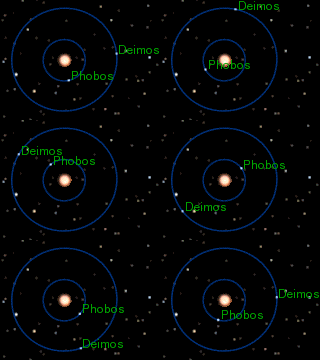
This picture shows Mars along with its two satellites Phobos and Deimos with Sun behind the Mars

Both these satellites are named after the sons of Ares (Mars) from Greek Mythology. These satellites are quite unique in their nature. They are actually escaped asteroids which are bound under the gravity of Mars. The picture on the left is Phobos and the one below is Deimos.


Asteroids are tiny pieces of rocks which are found in between the orbit of Mars and Jupiter which orbits the Sun. The picture below shows the Asteroid belt. Phobos and Deimos escaped from their orbit and they were captured by the strong gravitational force of Mars. Thus Phobos and Deimos were forced to orbit around the Mars.


Phobos has a unique property. It moves very close of the planet; it moves approximately at a distance of 9380 km away from Mars. Phobos also orbits at a very high velocity such that the time taken for Phobos to make one revolution around Mars is quicker than the time taken for Mars to make one rotation around its axis. Due to this Phobos appears to rise in the west and set in the east unlike any other satellites in our solar system. Also due to the high velocity Phobos rises and sets twice in one Mars day (which is also aprrox. 24 hrs.) This makes Phobos a unique satellite in our solar system.

The above picture shows the orbital motion of the two satellites of Mars.

1 May 2007

Picture of the Month - May 2007


(Click on the picture for the best view)

This series of images which was taken by a satellite and fused together shows the Earth during the night time. The continents are seen clearly due to the light of the Full Moon. But what is more astonishing is the brightness of the city lights. The city lights are so bright that it could actually be seen from space. These lights mark the developed areas on Earth. The eastern part of USA and west Europe are the brightest parts which are considered as the most developed areas. Whereas in Asia, Japan, east coast of China, Malaysia, Singapore and most parts of India are glittering with the city lights.

6 April 2007

The Green Sun

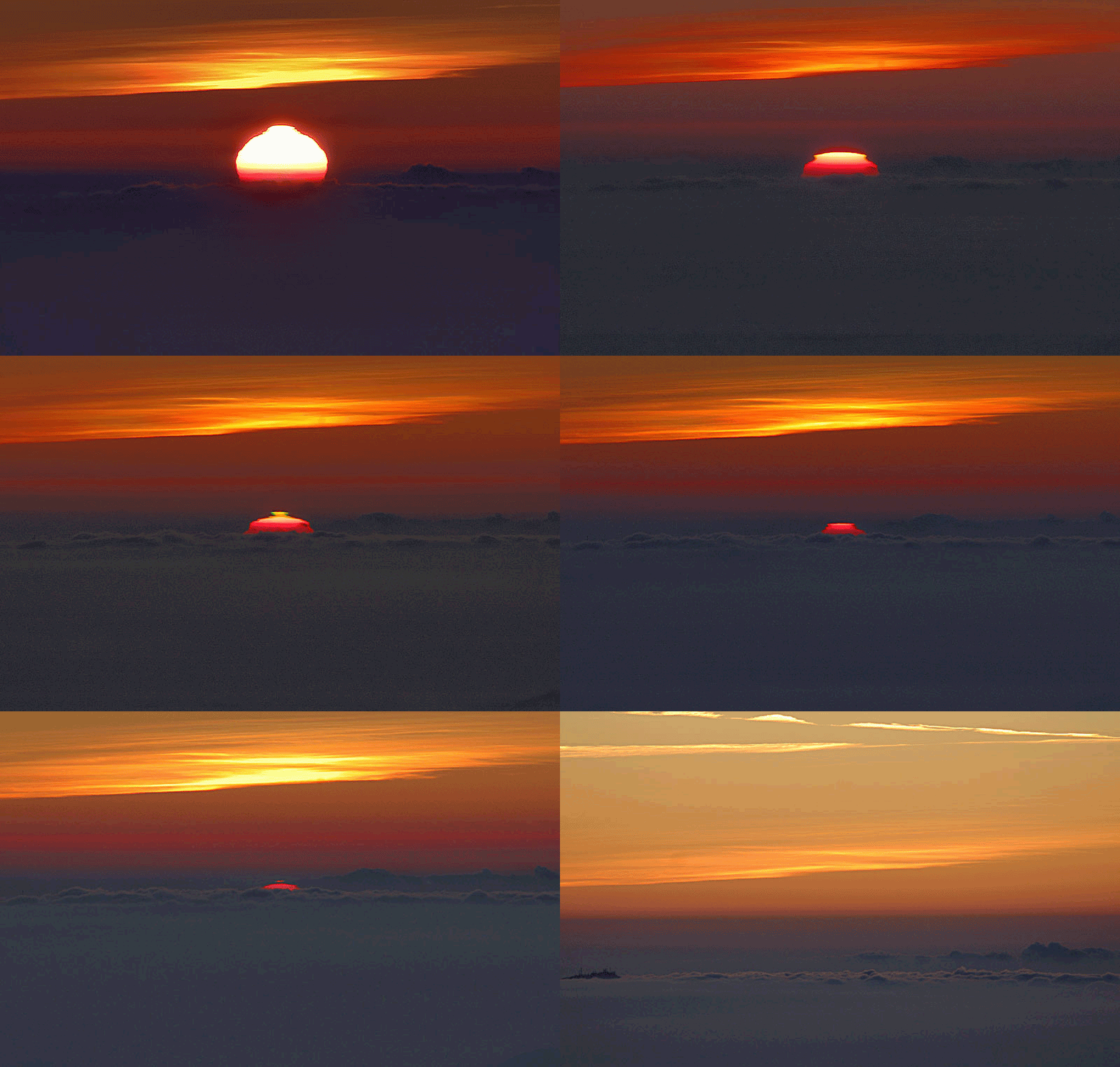
Confused by the title? I'm not trying to make an April Fool here. We have indeed witnessed the Green Sun. This video of the setting Sun from a site atop Mt. Autore (altitude 1,850 meters) in Italy has captured a green flash while the Sun was setting. How can the Sun turn green? Why does it occur? When can we observe this phenomenon?


(The time between frames in the gif image above varies from over one minute in the beginning to about one second as the flash becomes visible. If the image is not changing try to refresh the page.)


It is quite difficult to observe the Green Flash. It usually occurs during sunrise or sunset. This phenomenon is caused by the atmospheric bending or refraction of sunlight. Like a weak prism, the Earth's atmosphere breaks white sunlight into the seven colours, bending red colours slightly and green and blue colours through increasingly larger angles. When the sky is clear, a green flash just above the Sun's edge can sometimes be seen for a second or so, when the Sun is close to the horizon.

The above image was taken at the western horizon of Madagascar


This image of Green Flash was taken at the La Silla Observatory, in Chile, on October 15, 2005. The sun has almost set behind the mountain ranges of the western Chile when the Green Flash was observed.

Note: Click on the pictures for a better view.

Picture of the Month - April 2007


Brilliant Venus, slender crescent Moon, and lights along the Ponte 25 de Abril, which is a 2.3 km long suspension bridge across Tagus river glow against the western twilight in this lovely Moonset scene from Lisbon, the capital city of Portugal, recorded on March 20, 2007. In fact, such serene views were enjoyed across planet Earth this week, as the young Moon remained near the setting Sun following a partial solar eclipse, and Venus ruled as the evening star. Because of strong Earthshine - light from the sunlit Earth - even the Moon's night side is clearly visible in the picture.

5 February 2007

Picture of the Month - February 2007


This is dedicated to my friend who was asking me to change the usual topic - Astronomy. This brilliant photo was taken just a second before the Sand Storm that took place at Sumatra Island, Indonesia. This photo was found in a digital camera which was found about one month after the disaster.