6 June 2012

Venus Transit - An Experience


When I finished work early this morning, first thing I did was to take a snap of the Sun by covering my camera lens with a dense x-ray sheet. It wasn’t good enough. The picture of the Sun wasn’t really clear and I wasn't able to see the Venus.

I rushed home and took out the eclipse glass I created (by covering an X-ray sheet over my goggles). I wore my goggles and I was able to see the Sun clearly and most importantly a tiny little dot (Venus). For a moment I thought I imagined it!

Looking at the Sun and Venus through my own eclipse glass


Though I was able to see the Venus, I wasn’t satisfied with that. I needed to take a snap in order to preserve the moment. An idea struck me! I pulled out an old broken binocular and a cardboard. I made a circular hole in the cardboard and stuck the front end of the binoculars to it. I directed the binoculars to the Sun. Now the Sun light was passing through binoculars’ lens and the cardboard created a shadow around it.

Binoculars covered by the cardboard directed towards the Sun


I then placed an A4 sheet behind the rear end of the binoculars. Now the binoculars were creating a projection of the Sun. But no sign of Venus! After a lot of adjustments and focus, was finally able to see the Venus! And what’s better? I wasn’t just able to take a snap but a video as well.


Projection of the Sun from the Binoculars

I had to re-arrange the setup every few minutes due to the Sun’s movement in the sky. At around 9:00 IST a heavy wind blew away my setup and my binoculars were damaged beyond repair. I wanted to take snaps until Venus moves out of the Sun but unfortunately that wasn't possible.

Below are the snaps I took of the Venus Transit and also a video!

A video of the Projection (No Audio. And Venus wasn't clear since I had the flash on by mistake)


The above three pictures were taken at 7:18 IST


At 8:06 IST


At 8:38 IST


At 8:57 IST
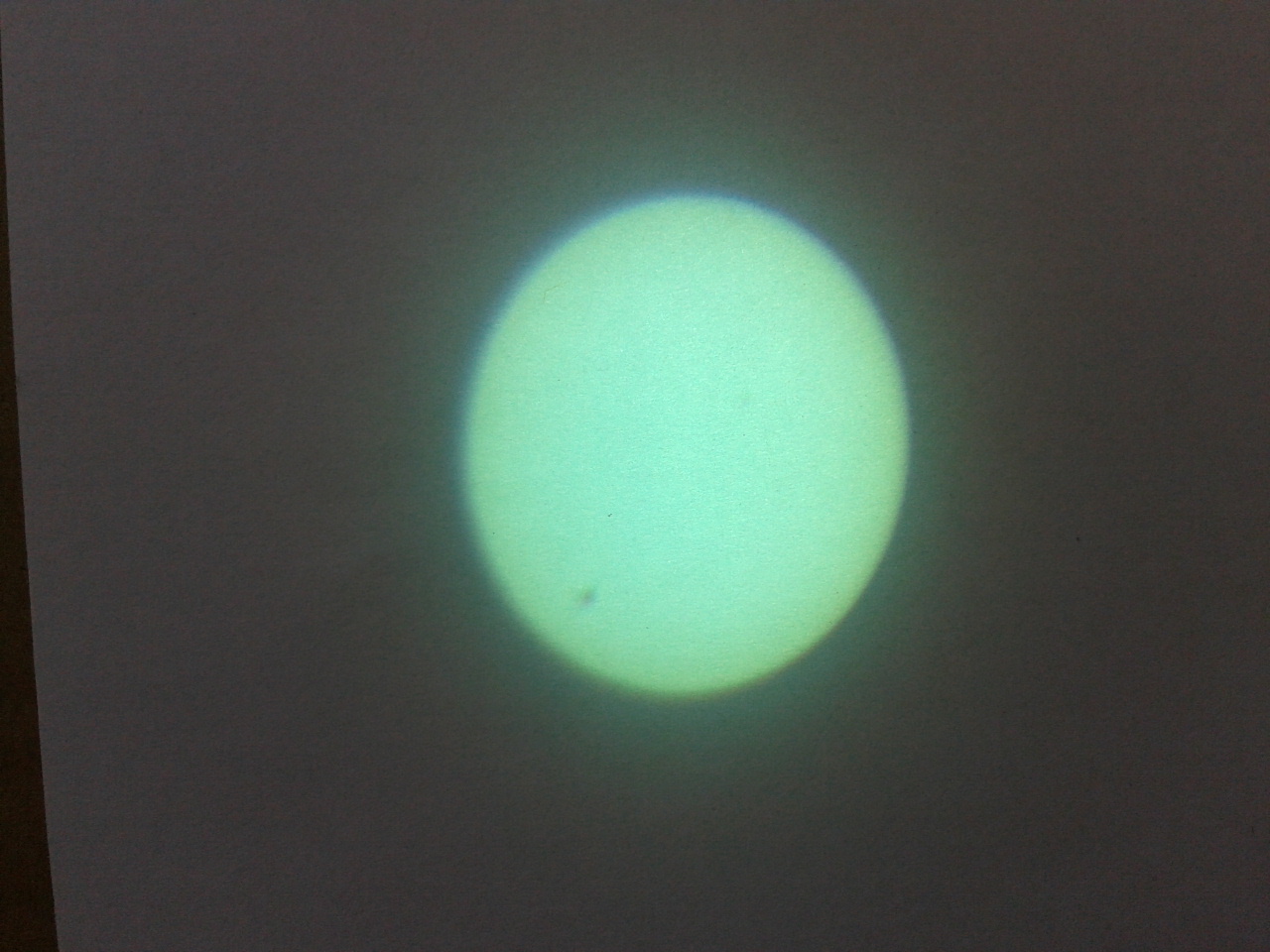

At 8:58 IST


My setup dismantled after my binoculars broke into parts


28 May 2012

Transit of Venus


In two weeks time (June 6, 2012, Wednesday) Venus, who has been glittering in the evening sky over the past few months will transit the Sun for the second time this century. The last time the transit occurred was on June 8, 2004. For those who missed it last time better catch it this time or you will never get another chance to see it. The next transit will occur only on December 11, 2117.

An animated view of Venus Transit in 2004


This year’s transit will occur between 3:39am IST to 10:19am IST. We would only be able to see it only after sun rise which is approximately 5:30am IST.

A transit is nothing but an occultation (just like an eclipse) when a planet (usually Mercury or Venus) comes in between Earth and Sun. Unlike the Moon, the planet cannot block the entire Sun since it is very small from Earth’s perspective. Hence we can see the planet only as a tiny dot over the Sun.

Best way to look at the transit is by using an Eclipse Shades or Welder’s Glass. DO NOT look directly into the Sun as it may cause damage to your eyes. Neither try to look at it using Sun Glasses as it does not block out the Sun’s brightness completely.


Venus Transits Past, Present and Future

Below are the three images of the upcoming Transit that I took using the application 'Stellarium'. The first image is how the transit will look at sunrise (5:40am IST). The second one is at 8:00am IST and the third is at 10:00am IST. Click on the images to get a clear view of the transit.

Transit at 5:40am IST

Transit at 8:00am IST

Transit at 10:00am IST


19 March 2011

Brightest Moon in Two Decades

Tonight the Moon will be closest to Earth in 18 years making it the biggest and the brightest since then. With all the hype created over the last week I really wanted to know what's the big deal. Last two days the moon really looked big enough at sun set. Just a while back I took a walk to my garden to check its brightness and it was bright enough. The shadow created by the moon was so dark and the garden was so well illuminated that I felt like sitting in there for an hour chilling out (I had bought a KFC bucket with chilled Pepsi) but for those ridiculous mosquitoes. Yet I feel all the hype ("Super Moon") wasn't worth it. It's still worth to have a look.

30 November 2010

Picture of the Month - November 2010


The above two images were taken on an early morning on 5th of November. This picture shows the thinnest Moon you can ever see. The thin crescent Moon was accompanied by a crescent Venus, shining bright, right before the sun rise. The crescent shape of the Venus is quite clearly seen in the above picture.

The phases of Venus was first identified by Galileo Galilei when he looked through his telescope for the first time on 1610, which confirmed the theory of heliocentric (Sun is in the center of the Solar System) which was proposed by Copernicus.

15 October 2010

Picture of the Month - October 2010


You must be wondering what those two bright objects at the bottom left of the picture is. It can't be Venus, since Venus doesn't have any satellite. It can't be Jupiter since none of the Jupiter's satellite are big enough as in the picture. It can't be Mars since Mars appears red. What else could it be? A binary star?

Well, that's it how Earth and Moon looks like from Mercury. This picture was captured by MESSENGER (MErcury Surface, Space ENvironment, GEochemistry and Ranging), a spacecraft sent to Mercury by NASA, which was launched in 2004.