15 July 2010

Picture of the Month - July 2010


This is one of the most beautiful pictures taken by International Space Station (ISS). While orbiting around the Earth in July 2006, the astronauts captured the Moon floating near the horizon and the Earth covered by a thick blanket of clouds. You can notice that a part of the moon appears blue. This is created by the atmosphere around the Earth. The Air Molecules in the atmosphere scatter the blue light which makes the sky look blue from Earth and the horizon look blue from space. Also the atmosphere deflect the Moon's light which makes the lower end of the Moon appear to fade.

15 June 2010

Picture of the Month - June 2010


The above image is a stunning false-colour picture of 'Cat's Eye Nebula' with a halo around it. The center white portion of the image is the Cat's Eye Nebula surrounded by a faint halo of gaseous material. Cat's Eye is one of the most famous Planetary Nebula which is believed to be around 1000 yrs old. The halo is said to be 3 light years across. Only recently the halos around many planetary nebulae have been discovered including this one.

4 June 2010

Cryogenic Technology

Well, throughout April you would have heard a lot of news about the cryogenic technology that ISRO used in the recent rocket that was launched and that it failed. Before explaining what the cryogenic technology is, let me explain about orbits.

There are several types of orbit for a satellite around Earth but let us consider two commonly used orbits. They are Elliptical Orbit and Geo-Stationary Orbit. Satellites in an elliptical orbit moves around the Earth in a ellipse with the height ranging from 800 - 2000 km from the Earth's surface.

Geo-stationary Orbits form a perfect circle and the satellites in Geo-stationary orbits moves along with the Earth's rotation, i.e. the satellite seems to be in a fixed position as seen from Earth. The height of these orbits are approx 30,000 km from the Earth's surface.

It is impossible to reach 30,000 km using normal propellant. This is where a cryogenic technology is used. Without cryogenic technology ISRO cannot move further in their space ambition.

About 22 yrs ago, ISRO requested NASA for the cryogenic technology which was refused. The reason was NASA feared that India may use this technology for creating missiles. ISRO then asked Russia to provide but due to the pressure from NASA, Russia refused to give it as well. In the last 18 yrs, ISRO researched on this matter and they created their own technology without any external help hence being called as the ingenious technology.

Unfortunately, their first mission on cryogenic technology failed. GSLV-D3 which was launched on 15th April, met with a malfunction in its third stage. This does not mean that the technology was the failure. ISRO will continue to test this technology and I hope it will succeed the next time. 

17 May 2010

Picture of the Month - May 2010


This most amazing picture is a combination of 8 images taken at Portsmouth, UK at 7:50 pm between April 4th to April 15th, 2010. This composite image shows the trail of Venus and Mercury with a beautiful backdrop. Venus (extreme left) was continuing to move away from the Sun during the time while Mercury (in the center) was rising until April 11th and then began to fall. The movement of both the planets are due to the revolution around the Sun with Mercury reaching the furthest distance from the Sun on April 11th. The thin crescent Moon joined this beautiful party on April 15th. Click on the picture for the enlarged version.

15 April 2010

Picture of the Month - April 2010


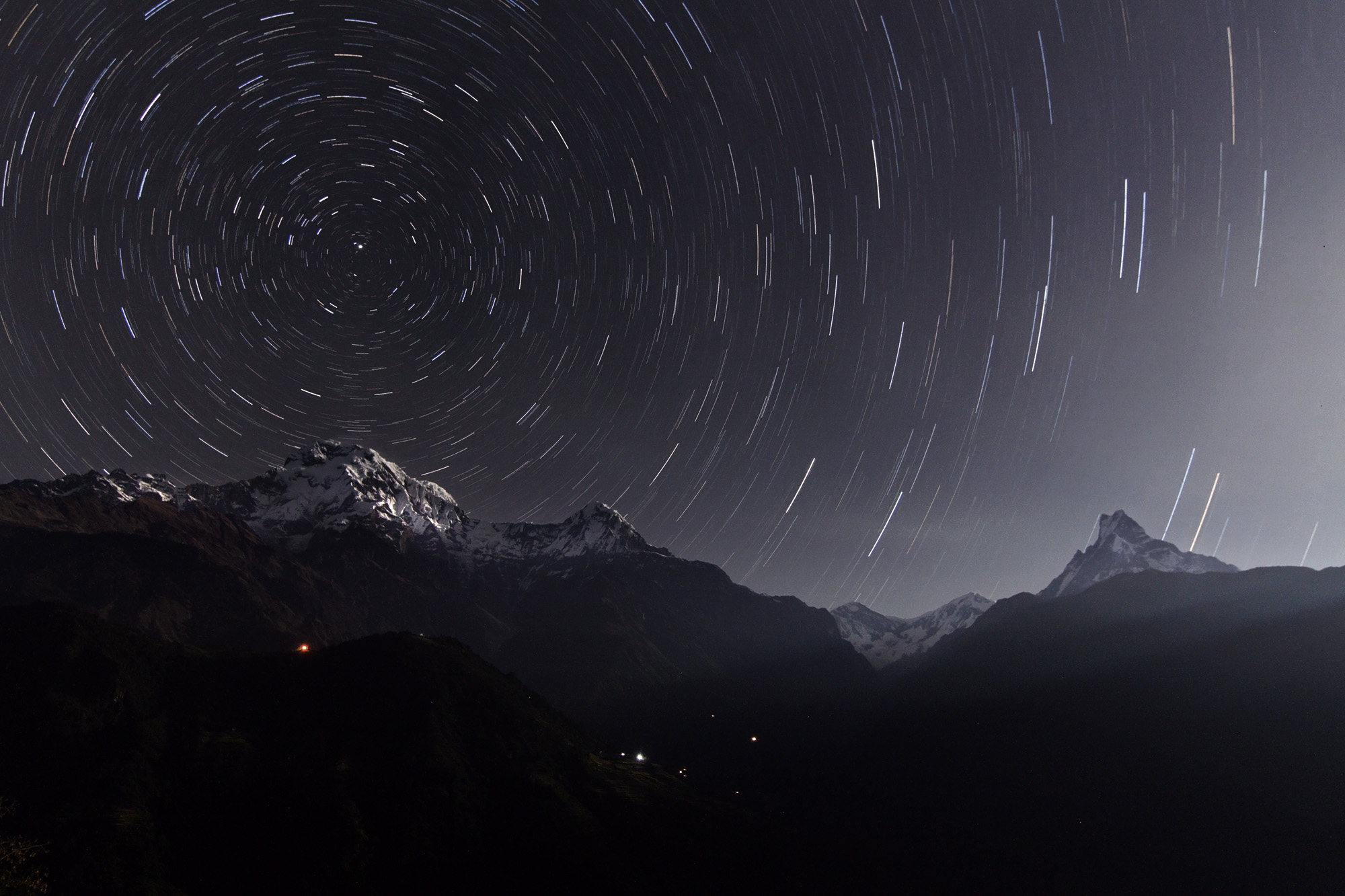
Another Startrail image taken along with the view of Annapurna ranges, Himalayas. This trail was taken during the entire day showing the complete Earth's rotation. Using this trail, the celestic North Pole can be identified, the center of the concentric trails. Also Polaris, the north star can be identified which is the bright one very near the center.