I found this video online that visually explains gravity. There are several such videos which explains why two objects with mass has gravity between them. What's fascinating in this video is that it not only explains the gravitational pull, but also the orbit of smaller objects around the larger objects, the elliptical orbit that planets take, the anti-clock-wise revolution of all planets around the sun (except of course Venus), and many more. The best part of this video is that it is not explained in computer graphics but explained practically. Watch and enjoy.
Showing posts with label Planets. Show all posts
Showing posts with label Planets. Show all posts
14 December 2014

11 May 2014
The Lord of the Rings
Hi all. It's been a while since I updated this blog. So here it is. Some of the pics of Saturn I took over a year ago.
Used a 6-inch Newtonian Reflector Telescope and Nikon D5100. Took these pics in a-focal method. Removed the camera lens and placed it facing the telescope eye-piece so that the telescope would act as a camera lens.
These are unadulterated pics taken at 20 sec exposure and I don't actually remember the ISO settings. These pics were taken from my terrace (in the middle of the city) so you would find some light pollution in them.


I was unable to stack these images and so I ended up photoshopping it. Removed the light pollution, increased the brightness and sharpened the image. Here is the result.

And here's a blown-up version of the same. If you look closely, you can make out the shadow of the planet on it's rings. Cassini's Division, not very clear. Hopefully when I get a better eye-piece.

Used a 6-inch Newtonian Reflector Telescope and Nikon D5100. Took these pics in a-focal method. Removed the camera lens and placed it facing the telescope eye-piece so that the telescope would act as a camera lens.
These are unadulterated pics taken at 20 sec exposure and I don't actually remember the ISO settings. These pics were taken from my terrace (in the middle of the city) so you would find some light pollution in them.


I was unable to stack these images and so I ended up photoshopping it. Removed the light pollution, increased the brightness and sharpened the image. Here is the result.
And here's a blown-up version of the same. If you look closely, you can make out the shadow of the planet on it's rings. Cassini's Division, not very clear. Hopefully when I get a better eye-piece.

6 June 2012
Venus Transit - An Experience
When I finished work early this morning, first thing I did
was to take a snap of the Sun by covering my camera lens with a dense x-ray
sheet. It wasn’t good enough. The picture of the Sun wasn’t really clear and I wasn't able to see the Venus.
I rushed home and took out the eclipse glass I created
(by covering an X-ray sheet over my goggles). I wore my goggles and I was able to
see the Sun clearly and most importantly a tiny little dot (Venus). For a moment I
thought I imagined it!

Looking at the Sun and Venus through my own eclipse glass
Though I was able to see the Venus, I wasn’t satisfied with that. I needed to take a snap in order to preserve the moment. An idea struck me! I pulled out an old broken binocular and a cardboard. I made a circular hole in the cardboard and stuck the front end of the binoculars to it. I directed the binoculars to the Sun. Now the Sun light was passing through binoculars’ lens and the cardboard created a shadow around it.

Binoculars covered by the cardboard directed towards the Sun
I then placed an A4 sheet behind the rear end of the binoculars.
Now the binoculars were creating a projection of the Sun. But no sign of Venus!
After a lot of adjustments and focus, was finally able to see the Venus! And
what’s better? I wasn’t just able to take a snap but a video as well.

Projection of the Sun from the Binoculars
I had to re-arrange the setup every few minutes due to the
Sun’s movement in the sky. At around 9:00 IST a heavy wind blew away my setup
and my binoculars were damaged beyond repair. I wanted to take snaps until
Venus moves out of the Sun but unfortunately that wasn't possible.
Below are the snaps I took of the Venus Transit and also a video!
A video of the Projection (No Audio. And Venus wasn't clear since I had the flash on by mistake)


The above three pictures were taken at 7:18 IST

At 8:06 IST

At 8:38 IST

At 8:57 IST
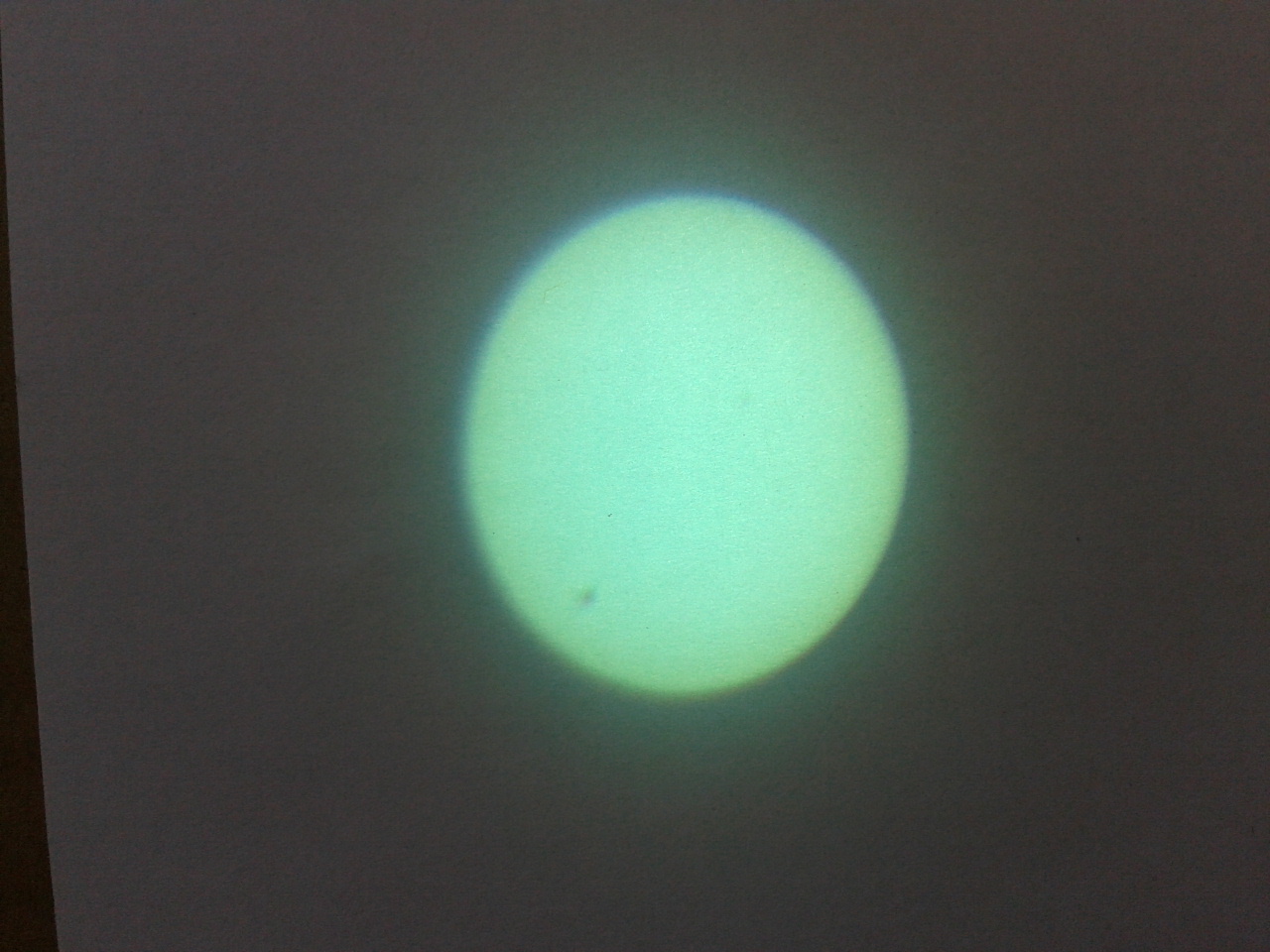
At 8:58 IST

My setup dismantled after my binoculars broke into parts
28 May 2012
Transit of Venus
In two weeks time (June 6, 2012, Wednesday) Venus, who has
been glittering in the evening sky over the past few months will transit the Sun for the second time this century. The last time the transit occurred was on
June 8, 2004. For those who missed it last time better catch it this time or
you will never get another chance to see it. The next transit will occur only
on December 11, 2117.

An animated view of Venus Transit in 2004
This year’s transit will occur between 3:39am IST to 10:19am
IST. We would only be able to see it only after sun rise which is approximately
5:30am IST.
A transit is nothing but an occultation (just like an
eclipse) when a planet (usually Mercury or Venus) comes in between Earth and
Sun. Unlike the Moon, the planet cannot block the entire Sun since it is very
small from Earth’s perspective. Hence we can see the planet only as a tiny dot over
the Sun.
Best way to look at the transit is by using an Eclipse
Shades or Welder’s Glass. DO NOT look directly into the Sun as it may cause
damage to your eyes. Neither try to look at it using Sun Glasses as it does not
block out the Sun’s brightness completely.

Venus Transits Past, Present and Future
Below are the three images of the upcoming Transit that I took using the application 'Stellarium'. The first image is how the transit will look at sunrise (5:40am IST). The second one is at 8:00am IST and the third is at 10:00am IST. Click on the images to get a clear view of the transit.

Transit at 5:40am IST

Transit at 8:00am IST

Transit at 10:00am IST
30 November 2010
Picture of the Month - November 2010

The above two images were taken on an early morning on 5th of November. This picture shows the thinnest Moon you can ever see. The thin crescent Moon was accompanied by a crescent Venus, shining bright, right before the sun rise. The crescent shape of the Venus is quite clearly seen in the above picture.
The phases of Venus was first identified by Galileo Galilei when he looked through his telescope for the first time on 1610, which confirmed the theory of heliocentric (Sun is in the center of the Solar System) which was proposed by Copernicus.
15 October 2010
Picture of the Month - October 2010

You must be wondering what those two bright objects at the bottom left of the picture is. It can't be Venus, since Venus doesn't have any satellite. It can't be Jupiter since none of the Jupiter's satellite are big enough as in the picture. It can't be Mars since Mars appears red. What else could it be? A binary star?
Well, that's it how Earth and Moon looks like from Mercury. This picture was captured by MESSENGER (MErcury Surface, Space ENvironment, GEochemistry and Ranging), a spacecraft sent to Mercury by NASA, which was launched in 2004.
27 September 2010
Picture of the Month - September 2010

20 September 2010
Jupiter At Its Brightest!
Anytime you look into the night sky you can see that the brightest object is the Moon, followed up by Venus and Jupiter. For the last few weeks I had been enjoying the beauty of Venus in the west and just as Venus sets, Jupiter rises in the east. I am waiting for the Venus to shift its position so that can I see Venus in the east and Jupiter in the west at the same time. I haven't seen them together since the 'Great Smile Incident', Dec 2008.

Also to add an interesting fact, Jupiter is found to be the closest to Earth tonight since 1963. It will be just 368 million miles away from Earth. So Jupiter is going to very bright today (though not as bright as Venus). So keep an eye on Jupiter tonight!

Venus on the top-left, Jupiter on the top-right, Moon in the bottom-middle. The Great Smile.
Also to add an interesting fact, Jupiter is found to be the closest to Earth tonight since 1963. It will be just 368 million miles away from Earth. So Jupiter is going to very bright today (though not as bright as Venus). So keep an eye on Jupiter tonight!
15 July 2010
Picture of the Month - July 2010

This is one of the most beautiful pictures taken by International Space Station (ISS). While orbiting around the Earth in July 2006, the astronauts captured the Moon floating near the horizon and the Earth covered by a thick blanket of clouds. You can notice that a part of the moon appears blue. This is created by the atmosphere around the Earth. The Air Molecules in the atmosphere scatter the blue light which makes the sky look blue from Earth and the horizon look blue from space. Also the atmosphere deflect the Moon's light which makes the lower end of the Moon appear to fade.
17 May 2010
Picture of the Month - May 2010

This most amazing picture is a combination of 8 images taken at Portsmouth, UK at 7:50 pm between April 4th to April 15th, 2010. This composite image shows the trail of Venus and Mercury with a beautiful backdrop. Venus (extreme left) was continuing to move away from the Sun during the time while Mercury (in the center) was rising until April 11th and then began to fall. The movement of both the planets are due to the revolution around the Sun with Mercury reaching the furthest distance from the Sun on April 11th. The thin crescent Moon joined this beautiful party on April 15th. Click on the picture for the enlarged version.
15 March 2010
Picture of the Month - March 2010
23 February 2010
Happy B'day Pluto
Pluto celebrated its 80th birthday on 18th of this month. Yes, 80 yrs since Clyde Tombaugh discovered the then farthest object of our solar system.
Using Newtonian Mechanics, Neptune's position was predicted before its discovery after analyzing the perturbation in the orbit of Uranus. After Neptune's discovery it was found that the Uranus' orbit was disturbed by another object other than Neptune. The start for the search of a new planet started in 1905 and it took nearly 25 yrs to discover it. Pluto was discovered just like any other planet - by relative movement.
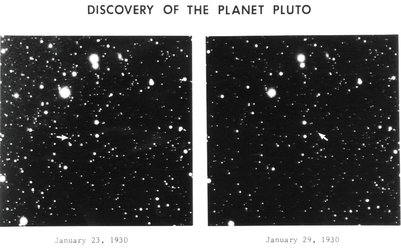
Pluto was so far that it was impossible to identify its diameter or mass. At first it was believed that Pluto was larger than Mercury. Pluto was considered to be the ninth planet of our Solar System until August 2006 when International Astronomical Union (IAU) brought out a definition for the term 'Planet' for the first time and thus Pluto was added in to the list of 'Dwarf Planets' along with the others discovered beyond the orbit of Neptune.
Pluto is now a distinct member of the Kuiper Belt (Similar to Asteroid Belt but this one is found beyond Neptune's Orbit). Three satellites were discovered orbiting Pluto namely Charon, Nix and Hydra.
Dog or Planet:

There is a very famous question which had been asked very often. Which came first? The Dog or the Planet? Pluto, the famous Disney Dog, as well as the planet Pluto were created/discovered in 1930. Some say that the dog was named after the planet and some say that the planet was named after the dog. The question which started in 1930 was answered only in 2006. Venetia Burney (who was 11 yrs old in 1930) was the one who suggested the name Pluto for the planet. It was believed that she was fascinated by the cartoon character Pluto and suggested the same name for the planet. But in 2006, the 88 yr old Venetia said, "The name had nothing to do with the Disney Cartoon. Mickey Mouse's dog was named after the planet, not the other way around."
Using Newtonian Mechanics, Neptune's position was predicted before its discovery after analyzing the perturbation in the orbit of Uranus. After Neptune's discovery it was found that the Uranus' orbit was disturbed by another object other than Neptune. The start for the search of a new planet started in 1905 and it took nearly 25 yrs to discover it. Pluto was discovered just like any other planet - by relative movement.
Pluto was so far that it was impossible to identify its diameter or mass. At first it was believed that Pluto was larger than Mercury. Pluto was considered to be the ninth planet of our Solar System until August 2006 when International Astronomical Union (IAU) brought out a definition for the term 'Planet' for the first time and thus Pluto was added in to the list of 'Dwarf Planets' along with the others discovered beyond the orbit of Neptune.
Pluto is now a distinct member of the Kuiper Belt (Similar to Asteroid Belt but this one is found beyond Neptune's Orbit). Three satellites were discovered orbiting Pluto namely Charon, Nix and Hydra.
Dog or Planet:

There is a very famous question which had been asked very often. Which came first? The Dog or the Planet? Pluto, the famous Disney Dog, as well as the planet Pluto were created/discovered in 1930. Some say that the dog was named after the planet and some say that the planet was named after the dog. The question which started in 1930 was answered only in 2006. Venetia Burney (who was 11 yrs old in 1930) was the one who suggested the name Pluto for the planet. It was believed that she was fascinated by the cartoon character Pluto and suggested the same name for the planet. But in 2006, the 88 yr old Venetia said, "The name had nothing to do with the Disney Cartoon. Mickey Mouse's dog was named after the planet, not the other way around."
19 December 2009
Picture of the Month - December 2009

Most of you would be familiar with the star trail images. Well, its just a photograph of the sky with the shutter opened for hours so that it can capture the trail or the movement of the stars. This image also shows the trail of the moon (you can easily guess) and also Jupiter (the bright trail very near the moon). This image also shows that the stars get dimmer as it reaches the horizon. That is because of the greater air masses at the horizon.
18 December 2008
Picture Of The Month - December 2008

This is not a very clear image but it is an astonishing one of the crescent Moon and Venus. This was viewed right here at Chennai on May 21st, 2004. It may be old but I would never forget this incident where the Moon forms a magical lamp with Venus brightly light at the end. This image was published in "The Hindu" on the next day. Ever since I started this blog I wanted to post this image but I never found it. By mere luck I found the old newspaper with this image and using its date I found the image in "The Hindu" website. I now hold the newspaper cutting (where the image is clear) as a possession. Click Here to read the article.
9 December 2008
Images Of Venus-Jupiter-Moon Smile
Here are some of the images of the Smile created by Moon, Venus and Jupiter in the sky on 1st December, 2008. Venus and Jupiter forms the eyes and the crescent Moon forms the mouth. The brighter eye to the left is Venus and the one of the right is Jupiter.
 The beautiful sky smile over the city of New York.
 Through the clouds.
 Close-up Shot
 It looks perfect here.
 This image is hours after the smile. Moon has moved past Venus and Jupiter.
 The beautiful sky smile over the city of New York.
 Through the clouds.
 Close-up Shot
 It looks perfect here.
 This image is hours after the smile. Moon has moved past Venus and Jupiter.
30 November 2008
Venus Jupiter Conjunction
Have a look at the west after sunset tomorrow, December 1st, 2008. You can see the three brightest objects of the night sky very close to each other. The crescent Moon, the goddess of love - Venus, and the king of the planets - Jupiter, are all close together forming a triangle between them. Venus and Jupiter move very close to each other which is called 'Conjunction'. Venus and Jupiter will only be 2 degrees apart.
 The above picture is an illustration of the conjunction between Venus and Jupiter and the triangle with the Moon. In India, it can be viewed after sunset and not at 9pm.
Venus is very bright, its magnitude being -4.02 (Lesser the magnitude, brighter the object). Venus can sometime reach the magnitude of -4.6. With the rest of the sky consisting of faint stars, the triangle between the three brightest objects of the night sky will be eye-catching.
 The above picture is an illustration of the conjunction between Venus and Jupiter and the triangle with the Moon. In India, it can be viewed after sunset and not at 9pm.
Venus is very bright, its magnitude being -4.02 (Lesser the magnitude, brighter the object). Venus can sometime reach the magnitude of -4.6. With the rest of the sky consisting of faint stars, the triangle between the three brightest objects of the night sky will be eye-catching.
1 October 2008
Picture Of The Month - September 2008

This picture was taken on September 1st, at Perth, Australia. This evening picture shows the crescent Moon along with three planets. The brightest of the three is Venus as the Evening Star. The tiny shining object above Venus is Mercury and the object at the top most is Mars. The three planets are found on the western sky after the sunset. This picture was taken across the Swan River and the six towers on the left of the image surrounds the Perth Cricket Stadium.
9 July 2008
Picture of the Month - July 2008

Here is a beautiful picture of Venus transitting Jupiter. This one is not an original picture. This is a screen shot from the Stellarium software. Do you want to view this in stellarium? Set your location to Chennai (India) and the date and time to November 22nd, 2065, 6:11pm. Click on either Venus or Jupiter and zoom in to see the beautiful transit. Venus transits only between 6:07 to 6:15 pm IST.
NOTE: Don't forget to turn off the ground and the atmosphere.
1 March 2008
Picture of the Month - February 2008

You must have known how Auroras look like from Earth. But how does it look like from space? This magnificient image gives you the answer. The International Space Station (ISS) pictured the above digitally sharpened image of the green aurora crawling over northern Canada. ISS reported that the auroras appears to crawl around like gaint amoebas, 300km above the surface. Still, the auroral electron and proton streams pose no direct danger to the ISS.
6 January 2008
Picture of the Month - January 2008

This is a spectacular image of a waning crescent Moon and Jupiter, which is seen at the bottom right of the image. The four sources of light around Jupiter are its four bright satellites namely - Ganymede, Callisto, Europa and Io. These satellites are known as the Galilean satellites as it was discovered by Galileo when he looked up at Jupiter for the first time in his newly formed telescope. The satellites can be seen clearly even through a small telescope.
Subscribe to:
Posts (Atom)