12 May 2013
Spotting the ISS
15 October 2010
Picture of the Month - October 2010
You must be wondering what those two bright objects at the bottom left of the picture is. It can't be Venus, since Venus doesn't have any satellite. It can't be Jupiter since none of the Jupiter's satellite are big enough as in the picture. It can't be Mars since Mars appears red. What else could it be? A binary star?
Well, that's it how Earth and Moon looks like from Mercury. This picture was captured by MESSENGER (MErcury Surface, Space ENvironment, GEochemistry and Ranging), a spacecraft sent to Mercury by NASA, which was launched in 2004.
15 July 2010
Picture of the Month - July 2010
This is one of the most beautiful pictures taken by International Space Station (ISS). While orbiting around the Earth in July 2006, the astronauts captured the Moon floating near the horizon and the Earth covered by a thick blanket of clouds. You can notice that a part of the moon appears blue. This is created by the atmosphere around the Earth. The Air Molecules in the atmosphere scatter the blue light which makes the sky look blue from Earth and the horizon look blue from space. Also the atmosphere deflect the Moon's light which makes the lower end of the Moon appear to fade.
4 June 2010
Cryogenic Technology
15 March 2010
Picture of the Month - March 2010
27 December 2009
ISRO Mars Mission
Chandrayaan-2 is set to launch in 2013 with a rover (robotic car) and based on the result of C2 ISRO may plan C3 with man landing on the moon. The discussion will start only after the success of C2. Also Manned Space Mission is on the way when India may send their own astronauts to space by 2016. ISRO will only start planning the Mars mission after the success of these missions.
China has already planned their Mars mission 'Yinghuo-1' which was set to launch on October 2009??? I have no idea what happened to this mission as no website seem to mention this. Even Wikipedia says that "it will be launched on October 2009" (note the future tense).
29 November 2009
Picture Of The Month - November 2009
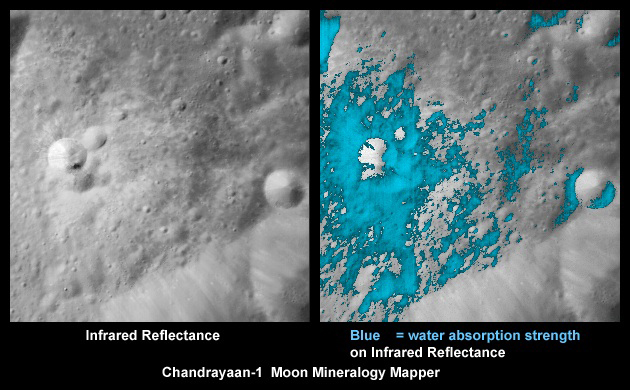
Water has been discovered on the surface of the Moon. Chandrayaan-1's Moon Mineralogy Mapper radios back that parts of Moon's surface absorb a very specific colour of light which are identified previously only with water. But there is no clue of what amount of water or what form exists there. A fascinating clue being debated is whether the water signal rises and falls during a single lunar day. If true, the signal might be explainable by hydrogen flowing out from the Sun and interacting with oxygen in the lunar soil. This could leave an extremely thin monolayer of water, perhaps only a few molecules thick. Some of the resulting water might subsequently evaporate away in bright sunlight. Pictured above, the area near a crater on the far side of the Moon shows a relatively high abundance of water-carrying minerals in false-color blue
25 December 2008
Chandrayaan 2 Design Complete
ISRO has collaborated with Russia for building the rover. The rover will have a soft landing on the moon unlike the MIP probe of Chandrayaan 1 which had a hard landing. The rover will collect the soil and rock samples from the moon, do in-situ tests and send the data to Earth through the orbiter. The estimated cost for Chandrayaan 2 is said to be Rs. 425 crore (US $ 90 million).
ISRO is currently earning about Rs 10 billion (Rs 1,000 crore) annually from its commercial wing. Chandrayaan is expected make it grow at 20 percent per year.
Anyways, I forgot to mention this in my previous post. The previous one was my 50th post. :)
21 December 2008
W2M Satellite Launched
Ariane-5 (rocket) was launched on sunday bearing two satellites, "W2M and Hot Bird 9". The space craft W2M, weighing 3463 kg was built by ISRO. This is the heaviest satellite ever built by ISRO and its capable of operating over 15 years. W2M is a communication satellite built on a commercial basis in partnership with EADS-Astrium of Europe.
23 November 2008
MoonLITE Mission
The 100-million-pound unmanned mission 'MoonLITE' would aim to understand the cause of mysterious quakes that vibrate through the lunar rock and put it into the satellite's orbit before firing a series of probes into the moon's surface.
The launch of MoonLITE (Moon Lightweight Interior and Telecommunications Experiment), will be announced next month after which engineers would work on the technical designs with an aim to launch the satellite between 2012 and 2014.
Backed by NASA, the spacecraft would also examine the chemical composition of the rocks and even search for water on the moon's surface.
The existence of moonquakes has puzzled scientists as the moon does not have the tectonic plate activity that causes quakes on the earth.
The MoonLITE mission is expected to fire four suitcase-sized penetrator probes into different points around the lunar surface.
Mission Aditya
The temperature of the solar corona goes beyond million degrees. From the Earth, corona can be seen only during total solar eclipses mainly due to the bright Solar disc and the scattering of the sunlight by the Earth's atmosphere. One has to go beyond the atmosphere to be able to mask the bright solar disc and study the corona.
"That's a mini satellite. In fact, the design is just getting completed. During solar maxim...which is happening...we would like to see the type of emissions which are taking place in the Sun and how it interacts with the ionosphere and atmosphere and so on. A basic understanding of the physical processes and continuous monitoring would help in taking necessary steps towards protecting ISRO's satellites either by switching them off or putting them on a stand-by mode as warranted by the background conditions.", says Madhavan Nair.
The satellite will remain in Earth's orbit and will study the Sun's Corona, sun spots and the Solar flare. 'Aditya' mission lies behind the international Sun missions 'Yohkoh', launched by Japan, collaborating with US and UK in 1991 and 'Hinode' in 2006. But 'Aditya' will be an Indian satellite with no collaboration.
19 November 2008
Bhuvan vs Google Earth
Bhuvan will use a network of satellites to create a high-resolution, bird's-eye view of India – and later, possibly, the rest of the world – that will be accessible at no cost online and will compete with Google Earth. If a pilot version passes muster, Bhuvan will be fully operational by the March. There are also plans to incorporate a Global Positioning System (GPS) into the online tool. Bhuvan will mainly focus on the sub-continent.

Bhuvan has an edge over Google Earth. Bhuvan has a lot more features than the famed Google Earth. Lets compare Bhuvan with Google Earth.
- Google Earth zooms in upto 200 meters, Wikimapia zooms upto 50 meters but Bhuvan can zoom upto 10 meters. The image is of a very high resolution such that you can get a view from the three storey building.
- Google Earth is a single layer information whereas Bhuvan is a multilayer information.
- In Google Earth the images are upgraded every 4 years whereas in Bhuvan, it is upgraded every year.
- Google Earth has no alternative viewing option. In Bhuvan you have an option of viewing on different dates.
- Google Earth uses international satellites for mapping but Bhuvan uses Indian satellites.
The prototype of Bhuvan will be ready by the end of November and ISRO is hoping to officially launch the service by March 2009.
ISRO is now booming itself since the launch of Chandrayaan.
18 November 2008
Chandrayaan's First Video
15 November 2008
Picture Of The Month - November 2008

Here is a colourful, close-up picture of the Moon taken by Moon Impact Probe (MIP), which is one of the 11 payloads of Chandrayaan-I. MIP was ejected by Chandrayaan on November 14th and had a crash landing (as planned) on the Moon at around 8:31 pm IST. MIP took this picture on its way to the surface of the moon. MIP (with the tri-coloured flag painted on its sides) landed on the Moon, making India the fourth country to make a physical contact on the Moon.
8 November 2008
Successfully in Orbit
Chandrayaan - I was launched on October 22nd, 2008. After its launch the space craft was put into the Earth's orbit, taking an elliptical path of 22,860 km as apogee (farthest point from the Surface of the Earth) and 255 km as perigee (nearest point from the Surface of the Earth). Since then the space craft was propelled, increasing its distance from Earth and nearing the Moon. Its final orbit around the Earth had an apogee of 3,84,000 km and perigee of 1,019 km until Lunar Orbit Insertion (LOI) started at around 5 pm for about 800 secs.
LOI is when a space craft is propelled so that it shifts from Earth's Orbit to the Lunar Orbit. At LOI the Earth and the Moon's gravitational force are almost equal. LOI is always a danger since even a small deviation by the space craft would make it crash into the Moon's surface or the Earth's surface or out into the deep space. Experts recall that about 30% of the unmanned moon missions by NASA and Soviet Union have failed during LOI.
Chandrayaan, after completing LOI at around 5:15 pm, is now making an elliptical orbit around the Moon with 7,500 km as aposelene (farthest point from the Surface of the Moon) and 500 km as pericelene (nearest point from the Surface of the Moon). Chandrayaan will further reduce its distance from the Moon to merely about 100 km. This may probably happen on November 14th or 15th.
4 November 2008
Picture Of The Month - October 2008


These are the first images of Earth taken by Chandrayaan-I on October 29th, 2008 using Terrain Mapping Camera (TMC) which is one of the 11 payloads of the spacecraft. The first image was taken at 8 am at a height of 9,000 km showing Northern coast of Australia. The second image was taken at 12:30 pm at a height of 70,000 km showing southern coast of Australia.
22 October 2008
Plans of Chandrayaan-II
Chandrayaan-II is an Indo-Russian joint venture. Russian federal space agency have already signed a pact with ISRO. "One of the two GSLV missions next year will carry Chandrayaan-II", says ISRO Chairman Mr. G. Madhavan Nair.
Chandrayaan-II would feature a lander and a rover for a soft land on moon. The rover will be designed by Russia’s federal space agency. India may be the second country to land a rover on the moon after USA during NASA's Apollo missions.
Mr. Nair expects more accomodating payloads (experiments) from other space agencies for the second odyssey just as in Chandrayaan-I. Chandrayaan-I carried 11 payloads of which 5 are Indian, 3 are from the European Space Agency, 2 from the NASA and one from Bulgaria.
"Even though China's and Japan's moon satellite (which are still in Moon's orbit) took high resolution pictures of the moon, they aren't as comprehensive as Chandrayaan-I", says former NASA associate administrator Scott Pace. The budget of Chandrayaan-I is also considerably cheaper than that of Japan or China.
This also strenghtens the space race in Asia. Japan, China and now India have successfully launched moon missions. China is leading in the race ever since they put taikonauts (Chinese Astronauts) in space in 2003 and had their first space walk last month. Even though this is India's first space expedition beyond Earth's orbit India is quickly catching up with China. India might even successfully land a rover and also humans on the moon's surface even before China.
Chandrayaan in Orbit
Chandrayaan was launched at 6:22am today and by 18 mins the satellite was put into orbit. So far there has not been a problem in the satellite or the rocket. The rocket projected through the designated path perfectly and ISRO says it has hit a “Bull’s Eye”.
I was eagerly waiting with a camera to shoot a video of the rocket on my terrace. Unfortunately over-cast did not help me at all. Thick clouds blocked the view of the rocket completely.
PSLV C-11 with Chandrayaan on its way to the Launch Pad
I will be constantly updating on the Chandrayaan mission and hope that it will successfully reach the moon’s orbit which is due in two weeks time.
20 October 2008
Mission Chandrayaan
Indian Space Research Organization (ISRO) reaches a new peak in their mission. In two days time Chandrayaan-I will be launched at Sriharikota on October 22, 2008 at exactly 6:20am IST.
Chandrayaan-I is an un-manned lunar spacecraft (meaning it carries no human). The spacecraft (Chandrayaan-I) will be launched by a modified version of Polar Satellite Launch Vehicle (PSLV-C11). The lunar probe would revolve around Moon for two years taking high resolution images of the lunar surface and also mapping its chemical and mineralogical content. It also concentrates on the polar region where water and ice could possibly be found. The satellite weighs about 1304 kg and the estimated cost is about INR 3.8 billion.
Chandrayaan-I under construction
The scientific payloads/experiments of Chandrayaan are TMC, HySI, LLRI, HEX, MIP, C1XS, SIR-2, SARA,
The Path of Chandrayaan
The Moon Exploration began on September 14, 1959, when Luna 2 was launched by
Chandrayaan-I will be followed by Chandrayaan-II in 2010/11. Chandrayaan-II will consist of the spacecraft itself and a landing platform with the Moon Rover. A moon rover is an automated motorized vehicle which moves around the surface of the moon, collecting soil and rock samples, do in situ chemical analysis and transmit it to the mother-spacecraft, Chandrayaan-II.
A artistic representation of the Chandrayaan-II rover
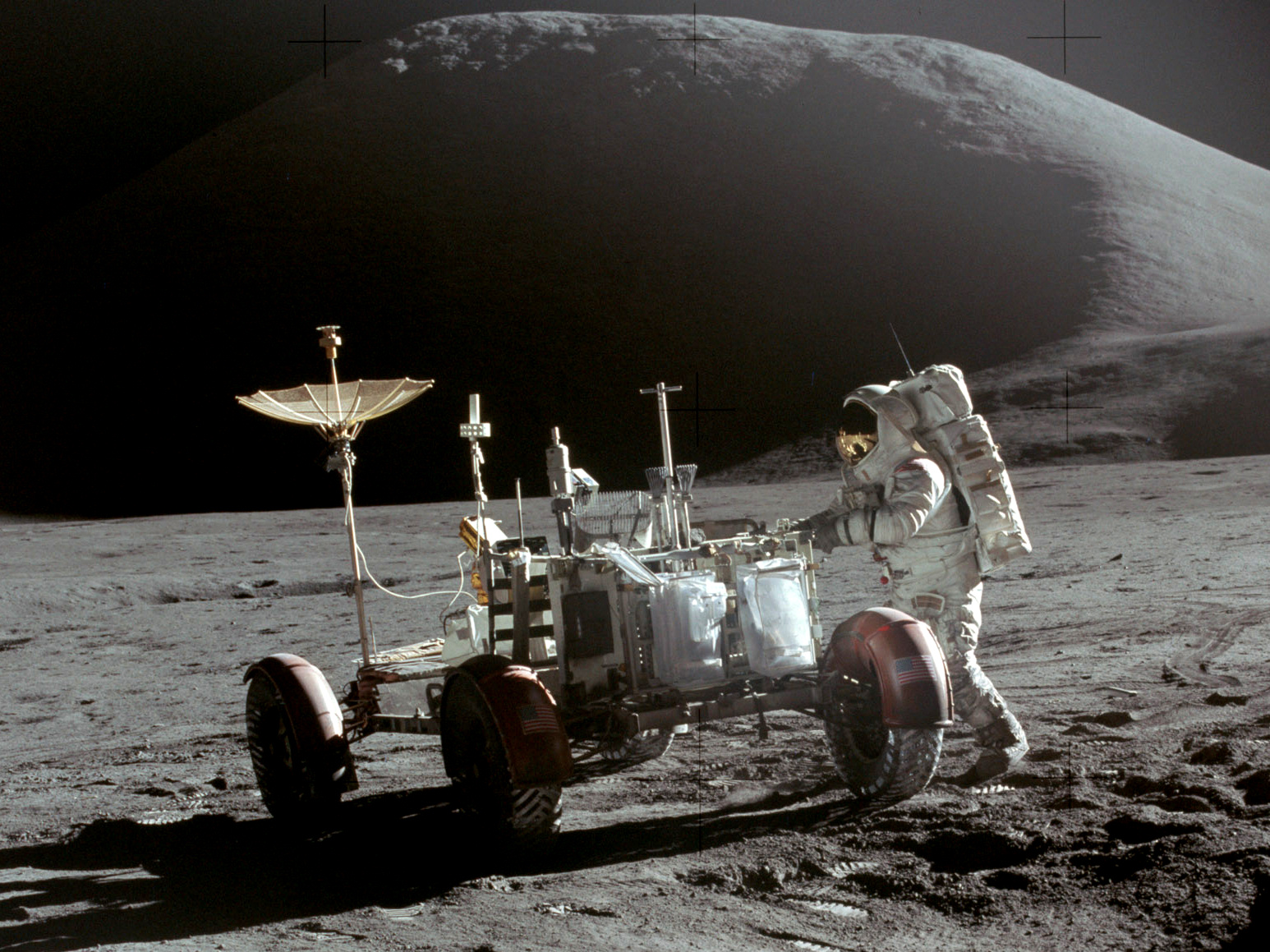
The Lunar Rover of Apollo 15 with James Irwin
ISRO also plans to undertake a manned space exploration by 2014 (send man to space).
If these missions succeed, then ISRO plans to send a manned mission to the moon on 2020. If ISRO succeeds in this,
Meanwhile
I just hope all this works out for
Chandrayaan-I is ready for the launch
People who live in Chennai can actually see the launch of Chandrayaan-I. Look at North at the exactly 6:20am on October 22nd. You should be able to see the rocket shooting upwards provided the clear sky.
31 August 2008
Picture of the Month - August 2008

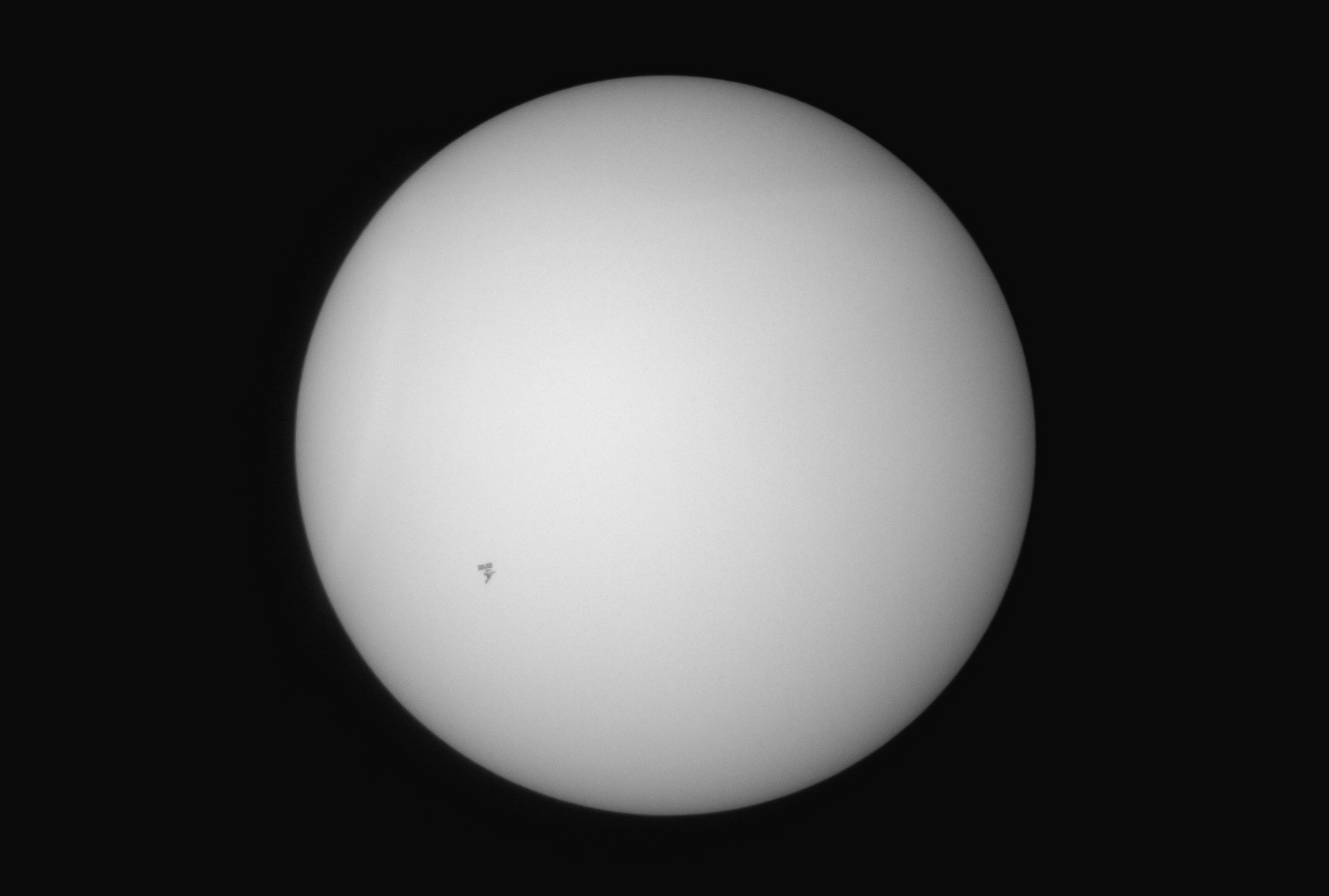
Do you see a Sun Spot on the Sun??? Click on the Picture to see it in a larger resolution. You can now clearly see that its not a Sun Spot but a space Station. It is the International Space Station (ISS) trasiting the Sun. As the ISS moves around the Earth, the space station (very rarely) appears to move across the surface of the Sun as in this Picture.